August 12, 2026
Aerothermal vs Geothermal in Ibiza: Which One for Your Villa?
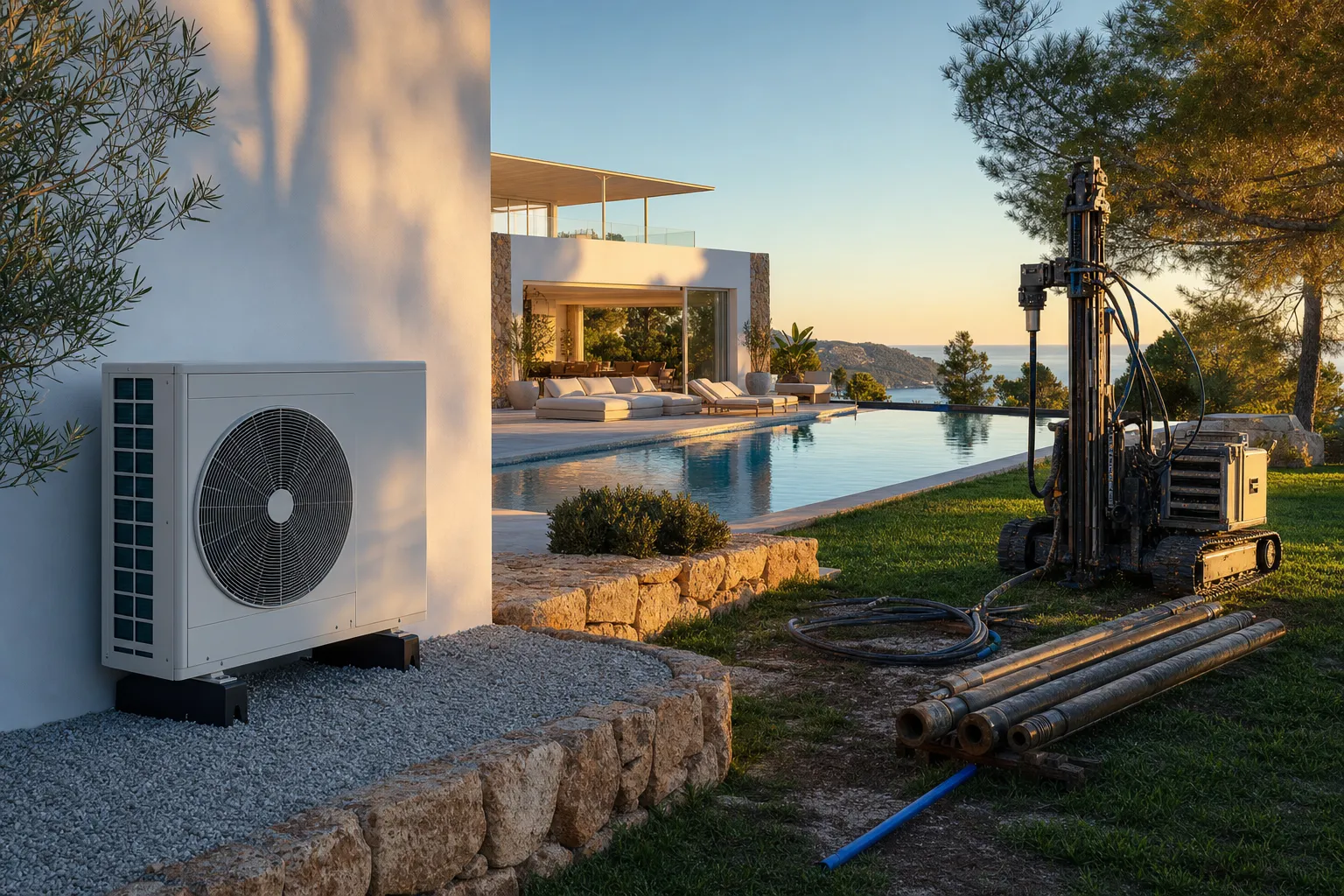
Aerothermal and geothermal systems are quietly replacing oil boilers and gas tanks in Ibiza’s premium villa market. Both run on electricity, both deliver heating, cooling and domestic hot water, and both qualify for renewable energy classifications. But on a 350 m² villa in San José or Santa Eulalia, picking the wrong one can mean a €25.000 difference in installation and a 30 % gap in annual running cost. This guide compares the two technologies for the specific climate, geology and use patterns of Ibiza villas.
What aerothermal and geothermal actually are
Both are heat pumps. They do not burn fuel — they move heat between an exterior source (air or ground) and your interior. For every kWh of electricity consumed, they deliver between 3 and 5 kWh of thermal energy. The difference is purely the source.
Aerothermal extracts heat from outside air, even at 0 °C, through a compressor unit that looks similar to a high-end air conditioner. Geothermal extracts it from the ground at 12-18 m depth, where temperature stays between 16 °C and 20 °C all year, through buried collector loops or vertical probes. The colder the outside source, the harder a heat pump works — which is why ground temperature, being remarkably stable, gives geothermal a permanent efficiency advantage.
The decisive comparison for an Ibiza villa
| Criterion | Aerothermal | Geothermal |
|---|---|---|
| Installation cost (350 m² villa) | €12.000–18.000 | €28.000–45.000 |
| Annual COP (real, Ibiza climate) | 3.2–4.1 | 4.5–5.5 |
| Lifespan | 15–20 years | 25–35 years (heat pump) / 50+ (loops) |
| Outdoor visual impact | External unit visible | Zero after installation |
| Acoustic impact | 45–55 dB outside | None |
| Works in rural land (suelo rústico)? | Yes, simple installation | Requires drilling license |
| Heating + cooling | Yes | Yes |
| Domestic hot water | Yes | Yes (better at peak loads) |
| Annual electricity (3 occupants, year-round) | €1.400–1.900 | €900–1.300 |
| Payback vs aerothermal (only) | — | 9–14 years |
“On Mediterranean islands with mild winters and very hot summers, geothermal becomes financially competitive only on villas above 300 m² with year-round occupation or pool heating. Below that threshold, modern aerothermal with inverter compressors is the rational choice.”
IDAE (Instituto para la Diversificación y Ahorro de la Energía), 2024 technical bulletin on heat pumps in coastal climates
Why Ibiza’s geology matters more than you think
Geothermal installation in Ibiza is not the same project as in Madrid or Bilbao. Three local factors change the equation.
Bedrock depth. Many San Carlos and Santa Eulalia plots reach hard limestone at 2-4 m, which forces vertical probes (more expensive than horizontal loops) and dedicated drilling machinery brought from the peninsula. Salinity. Plots near the coast — Cala Llonga, Es Cubells, Talamanca — can have brackish groundwater that requires stainless or HDPE loops instead of standard plastic. Heritage protection. Anywhere in BIC-protected zones or close to archaeological sites needs additional permits, often adding 6-10 weeks to project timeline.
Aerothermal sidesteps all three issues. For most villas under 250 m² with a discreet placement for the outdoor unit, it is installed in two to three days. Which is why 80 % of the premium renovations we deliver in 2025-2026 use aerothermal, not geothermal — even on properties where budget would allow either.
When geothermal genuinely pays off in Ibiza
There are clear cases where the higher investment makes sense:
- Villas above 400 m² with year-round occupation. The 30 % running-cost saving over a 25-year horizon recovers the differential cleanly.
- Properties with heated pools used 8+ months/year. Pool heating is the load where geothermal’s higher COP shines.
- Premium rental villas with prestigious energy certificates as part of the marketing. Geothermal frequently delivers A+ where aerothermal lands at A.
- Plots without acceptable outdoor unit placement. Strict community rules, restrictive heritage zones, or owners who simply refuse visible external equipment.
- New constructions where geothermal loops can be buried during excavation. Installation cost drops 20-30 % when combined with foundation work.
When aerothermal is the rational choice
The opposite case applies to most villas under 300 m², seasonal-use second homes, properties on stony substrate or coastal salinity, and budgets that prefer to invest the €15.000-25.000 differential elsewhere — for example, in proper photovoltaic solar panel installation that turns the aerothermal’s electric consumption near zero. A well-sized aerothermal system + 6-8 kWp solar PV beats geothermal in cost-effectiveness for the majority of villas on the island.
How IBOSSIM approaches the decision
Before recommending either system, we run an energy demand simulation for the specific villa: real thermal envelope, glazing, orientation, occupation pattern, pool use, hot water consumption. We cross those numbers with the geotechnical and bureaucratic feasibility of the plot. The output is not “aerothermal vs geothermal” but the specific brand and capacity that delivers the lowest 25-year total cost of ownership for that property.
In most projects this analysis is part of a wider villa renovation, where we coordinate the system selection with insulation upgrades, window replacement, and PV deployment to maximise the result rather than treating it as a standalone purchase. Some clients pair this with a complete landscape redesign where the geothermal loop trenches are integrated with garden irrigation infrastructure.
Frequently asked questions
Can I use the same system for heating, cooling and hot water?
Yes. Both aerothermal and geothermal cover all three needs in a single unit. Domestic hot water typically uses a 200-300 L stratified tank coupled to the heat pump. Cooling in summer is delivered through the same hydraulic loops, switching the refrigerant cycle.
What maintenance does each system need?
Aerothermal: annual cleaning of the external unit’s fins, pressure check, refrigerant inspection (about €150-220 a year). Geothermal: visual inspection of the ground loops once a year, pressure verification, antifreeze top-up every 5-7 years (about €80-150 a year). Geothermal heat pumps themselves last roughly 25 years, almost double the aerothermal lifespan.
Is geothermal possible if my villa is already built?
Yes, but with constraints. Vertical probes (drilled 80-150 m down) can be installed on most plots without affecting the existing villa. Horizontal collectors require 200-400 m² of garden space available for excavation. In neither case is the existing construction modified — only the technical room where the heat pump goes.
Does either system make sense for a seasonal villa used 3-4 months a year?
Aerothermal almost always; geothermal almost never. The economic case for geothermal depends on running it many hours per year. A property used only in summer rarely recovers the additional investment within reasonable horizons. Aerothermal, with its lower upfront cost, makes sense even with seasonal use.
Can I combine either with solar PV?
Yes, and we strongly recommend it. A 6-8 kWp solar installation covers 60-80 % of aerothermal annual consumption in Ibiza’s solar conditions. With geothermal, a smaller 4-6 kWp installation can cover near 100 % of running cost. Combining heat pump and PV is what produces A+ energy certificates and the best total ownership cost.