July 8, 2026
Balearic Rural Land Amnesty Law 2026: Which Buildings Can Be Legalized and How
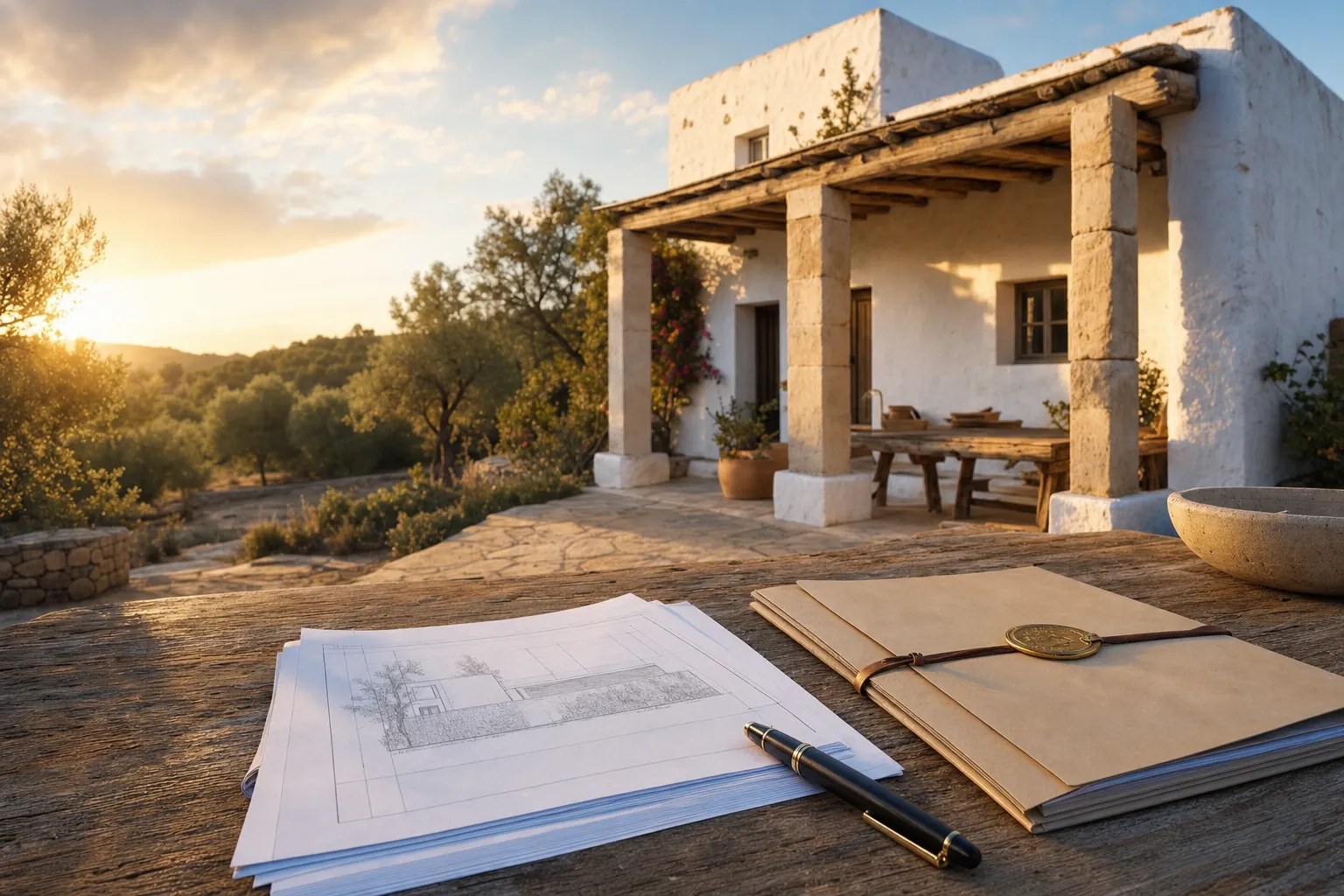
Across rural Ibiza there are thousands of buildings — extensions, ancillary buildings, full villas — that physically exist but legally don’t. The Balearic Rural Land Amnesty Law (Decret-llei 6/2023 and its subsequent modifications) is the regulatory window that lets owners legalize many of these constructions without demolishing them, provided they meet specific criteria and the procedure is started before the legal window closes. For owners of rural properties in Ibiza this is the single most important piece of regulation of the decade, and the most under-acted-on.
This guide explains who qualifies, what the legalization process actually involves, the realistic costs and timelines, and the practical decisions an international owner has to make before engaging an architect. Written for owners of rural villas, fincas or rustic land in Ibiza who suspect — or know — that part of their property’s documentation doesn’t match what’s standing on the land.
What the law actually does
Decret-llei 6/2023, approved by the Govern de les Illes Balears, opens a regularization route for buildings on rural land (suelo rústico) that are fuera de ordenación (outside the legal planning order) but meet specific conditions. The law doesn’t legalize everything — buildings that violate environmental protection, on flood-risk land, or on land protected by Natura 2000 generally remain ineligible. But for the typical case of an Ibiza rural villa with an extension built without permit, an annex added without paperwork, or a finca whose dimensions don’t match the cadastre, the law provides a real path.
The motivation behind the law is pragmatic: tens of thousands of buildings exist on the islands without full legal documentation, and the alternative to a regularization framework is mass demolition (politically and economically unfeasible) or eternal legal limbo (commercially unworkable for owners trying to sell or finance). The law trades a regulatory fine and a procedural cost for legal certainty going forward.
Who qualifies — and who doesn’t
The eligibility criteria are specific and the practical decision usually requires an architect-led feasibility study. Broadly:
- Eligible (typically): buildings completed at least 8 years before the law’s entry into force; on land that’s classifiable as rustic but not in maximum protection categories; without active sanctioning procedures or judicial demolition orders.
- Eligible with conditions: buildings on rural land with some protection level — may require specific environmental mitigation measures or limited reduction of footprint.
- Not eligible: buildings on land classified ANEI (Área Natural de Especial Interés) maximum protection, on the maritime-terrestrial public domain, in flood-prone zones, or with active demolition orders.
- Not eligible (procedural): buildings whose construction post-dates the law’s window, or whose owner has a pending sanctioning proceeding for that specific construction.
The single most useful first step is an eligibility study by a Balearic-licensed architect: cadastral verification, aerial photo dating to establish minimum age, zoning lookup, and a check against existing sanctioning records. This study costs €600–1,500 and answers the binary question — proceed or don’t — before any larger investment.
Before vs after the law: the practical comparison
| Aspect | Before the law (no path) | Under Decret-llei 6/2023 |
|---|---|---|
| Legal status of an undocumented extension | Permanent fuera de ordenación, sanctionable | Regularization possible, formalized in registry |
| Sale of the property | Required disclosure, price discount typically 15–30% | Sellable as fully legal post-procedure |
| Financing (mortgage) | Most banks refuse irregular properties | Eligible for mortgage after regularization |
| Renovation / future works | Major restrictions on what can be modified | Standard licensing rules apply post-regularization |
| Tourist rental (VTV) | Typically refused if irregular construction documented | Eligible once regularized |
| Procedural cost | N/A (no path) | €8,000–35,000 typical for a villa case |
| Procedural timeline | N/A | 9–18 months |
| Limitations on regularized building | N/A | Some future expansions may be capped |
“El Decret-llei 6/2023 ofrece una vía de normalización para edificaciones en suelo rústico que, cumpliendo determinados requisitos, pueden incorporarse al orden urbanístico vigente. Es una oportunidad histórica para regularizar situaciones que, sin esta norma, no tendrían solución técnica viable.”
Conselleria d’Habitatge, Territori i Mobilitat — Govern de les Illes Balears
The five-step legalization process, in real terms
The procedure is described in the Decret-llei in abstract terms; in practice it breaks down into five sequential steps. Each has its own paperwork and its own pitfalls.
- Eligibility study (1–3 weeks): as described above. Decides go / no-go.
- Technical project (8–14 weeks): as-built blueprints by architect, structural certification, energy efficiency certificate, environmental impact assessment if applicable. This is the largest single line item — typically €4,000–12,000 for an Ibiza villa.
- Administrative filing (variable): the project is filed with the municipality first and then the Consell Insular d’Eivissa. Most cases involve back-and-forth on documentation gaps; budget 2–4 months for this phase.
- Consell Insular review (3–8 months): the Consell’s territorial and environmental commissions review and either approve, request modifications, or deny. Modification requests are normal and don’t usually mean denial — they mean iterating on technical details.
- Final certificate and registry update (4–8 weeks): once approved, the property’s registry entry is updated to reflect the now-legal state. This is the step that finally enables sale, mortgage, and full renovation.
Total elapsed time: 9–18 months. The variance comes mostly from Consell Insular review time, which depends on caseload and complexity. Property owners who file early in the law’s window typically experience shorter timelines than those who wait until the window is closing.
The cost reality: what you actually pay
The procedural cost for legalizing a typical rural villa in Ibiza under Decret-llei 6/2023 breaks down approximately as follows:
- Eligibility study + architect lead: €1,500–3,000
- Full technical project (as-built + certifications): €4,000–12,000
- Surveyor topography + cadastral update: €1,200–3,000
- Administrative tasas (municipal + Consell): €2,000–8,000 (proportional to building value)
- Regularization tax (one-off, set by the law): €1,500–8,000 (proportional to footprint and zone)
- Notary + registry: €500–1,500
Total realistic range for a typical Ibiza rural villa case: €10,700 to €35,500. The variance correlates with the size of the irregular construction, the protection level of the zone, and the complexity of the documentation gap. The investment is recovered immediately the moment the property’s legal status enables a sale at the post-regularization price.
The decision tree for an international owner
For most international owners of rural Ibiza properties, the strategic decision tree looks like this:
- If you intend to sell in the next 5 years: regularize now. The 15–30% price discount on irregular properties almost always exceeds the regularization cost. The mortgage availability for the buyer alone justifies the procedure.
- If you intend to renovate significantly: regularize first. Major renovation on an irregular property is essentially impossible — the licencia de obra would expose the underlying irregularity and trigger sanctioning.
- If you intend to operate as VTV (tourist rental): regularize. Tourist registration is increasingly difficult on irregular properties; municipal scrutiny has tightened since 2024.
- If the property is in long-term family use with no foreseeable sale: the case is weaker but still positive. The law’s window will close at some point; once closed, the option disappears for a generation.
How IBOSSIM coordinates a legalization case
Although the legalization itself is led by an architect (and we don’t act as architect on these cases), IBOSSIM serves as project coordinator for owners who want a single point of contact through the procedure. Three protocols:
First, eligibility verification before any larger investment. We coordinate the eligibility study with a Balearic-licensed architect and deliver a clear go / no-go in 2–3 weeks. If the case is no-go, the owner has lost €1,500 instead of €15,000.
Second, technical project quality. The technical project filed with the Consell determines the speed of approval — incomplete or unclear projects bounce. We work with architects whose Decret-llei projects we’ve seen approved without major modifications, which translates into a 3–6 month time saving on average vs choosing an architect blind.
Third, post-regularization renovation. Most cases we coordinate proceed directly to a full villa renovation once legal status is achieved. The regularization is the gating step; the renovation is the value-creation step. We coordinate them as a single project so that owners aren’t bouncing between vendors.
FAQ
How do I know if my property has an irregular construction?
The simplest test: compare what’s physically built to what’s described in the property’s nota simple registral and cadastral plan. Discrepancies (extra rooms, larger footprint, additional ancillary buildings) indicate undocumented construction. An architect’s eligibility study formalizes this in 1–3 weeks.
What’s the deadline to file under Decret-llei 6/2023?
The current window has been extended multiple times since 2023. As of 2026, files are still being accepted, but the political signal is clear that the window will eventually close. The conservative recommendation: file in the next 12 months if eligible.
Will regularization affect my property tax (IBI)?
Possibly. The cadastral update post-regularization typically reflects the actual built area, which can increase IBI assessment. The increase is usually modest (€200–800/year for a villa case) and dwarfed by the property value uplift.
Can I sell the property in the middle of the regularization process?
Technically yes, but few buyers will accept the risk. The pragmatic approach is to complete the regularization first; the few buyers who would proceed mid-process typically demand additional price discount to absorb the risk, which negates the benefit.
What if the regularization is denied?
Denial usually means the case wasn’t eligible from the start (which a proper eligibility study should have caught) or that the technical project had material errors (correctable on resubmission). True final denials — eligible case denied on substance — are rare and almost always appealable.
Regularization under Decret-llei 6/2023 is a generational opportunity for owners of rural Ibiza properties with documentation gaps. The window won’t stay open forever, and properties that don’t take advantage of it will likely face increasingly difficult conditions for sale, financing, and renovation in coming years. The first step is an eligibility study — small investment, binary answer.
Related reading: Building Permits in Ibiza 2026 · Transforming a Traditional Finca into a Modern Paradise · Complete Guide to Villa Renovation.