May 27, 2026
Green Roofs Ibiza Villas: Types, Installation & Real Benefits
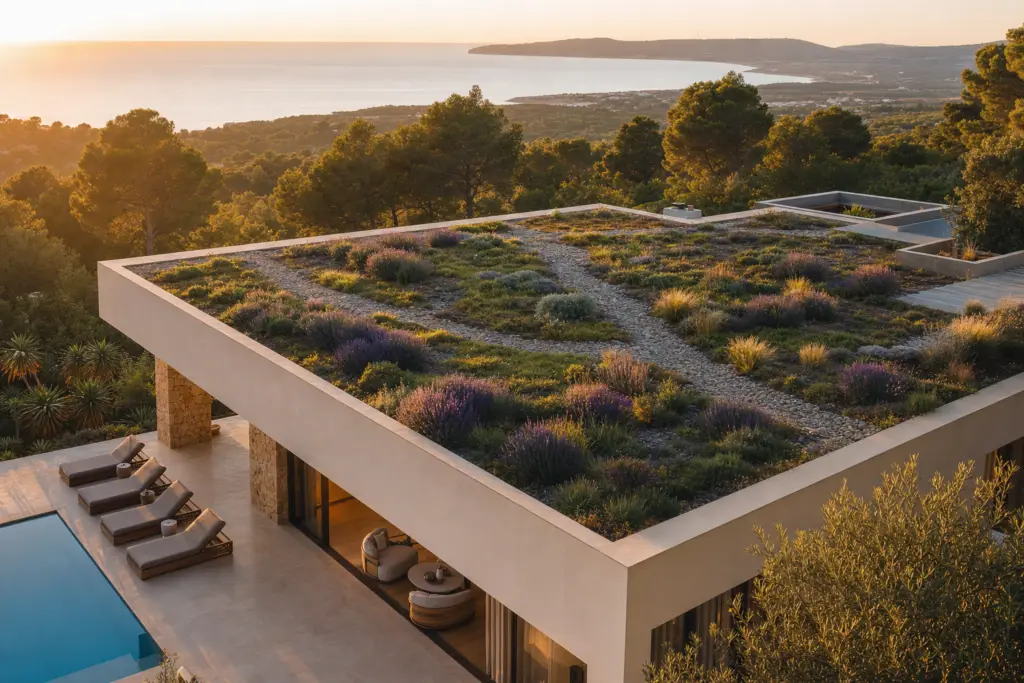
A green roof on a luxury Ibiza villa isn’t a sustainability gesture, it’s a thermal weapon. The same roof that would otherwise cook the floor below at 70 °C in August becomes a vegetated insulating layer that drops indoor temperature by 4–6 °C, cuts air-conditioning consumption noticeably and disappears visually into the surrounding landscape when viewed from the hillside above. Done right, it pays for itself in roughly a decade through energy savings and adds visible value at appraisal time.
This guide explains how green roofs actually perform in Mediterranean climate, the three system types (extensive, semi-intensive and intensive) with their real differences in weight, plants and cost, the structural and waterproofing requirements that decide whether your existing roof can take one, and the maintenance schedule a Pitiusan green roof actually needs to look good in year 10, not just year 1.
Why a green roof works specifically well on an Ibiza villa
The thermal performance of a roof is usually the weakest link in the whole envelope. Even when walls and windows are well insulated, the roof in coastal Mediterranean climate receives the highest radiation, the most extreme temperature swings and the most direct UV exposure. On a typical flat concrete roof in Ibiza, surface temperature in August routinely exceeds 65 °C; the slab transmits that heat into the rooms below for 6–8 hours after sunset, defeating any night-time natural ventilation strategy.
A green roof breaks that chain in three independent ways. First, the vegetation reflects 20–30% of incoming radiation by reflectance and absorbs another portion through photosynthesis instead of converting it to heat. Second, the substrate layer (soil and growing medium) acts as a thermal mass that smooths out daily temperature peaks. Third, plant evapotranspiration removes heat from the system as latent heat — the same cooling principle as sweating. The combined effect, measured on multiple Mediterranean installations, brings indoor temperature 3–6 °C below an equivalent bare-roofed building.
The second benefit is acoustic: vegetation and substrate absorb a significant fraction of airborne sound. On terraces with overhead aircraft routes (common over Ibiza’s northern coast), this is a real comfort upgrade that’s often impossible to retrofit any other way. Third benefit: rainwater retention. A standard extensive green roof retains 50–70% of annual precipitation, releasing it gradually instead of dumping it into the storm drain. In an island with chronic water restrictions, this matters.
The three system types: extensive, semi-intensive and intensive
Green roof is not one product. There are three families, and choosing wrong is the most common reason installations fail or look terrible by year 3. The difference between them is the depth of growing medium, which determines almost everything else: weight on the structure, viable plants, maintenance burden, and cost.
In Ibiza luxury villa context, extensive systems with Mediterranean species are the right answer about 80% of the time. They’re light enough that most existing roof slabs can take them, they don’t need irrigation after year two, and they look intentional — like a meadow on top of the building — rather than fighting the climate with thirsty plants. Intensive systems are reserved for rooftop gardens you actually want to walk on and use as living space.
“A vegetated roof system, properly designed and maintained, can reduce thermal demand of the spaces below by 15–25% in Mediterranean climate, retain 50–70% of annual rainfall, and provide an additional sound insulation of 8–10 dB compared to a conventional flat roof.”
ASESCUVE — Asociación Española de Cubiertas Verdes, Guía técnica de cubiertas vegetadas
Layers of an Ibiza-grade green roof, from substrate to slab
A green roof is a stratified system. Skip a layer or use the wrong product on one of them, and the whole roof fails 4–7 years later — usually expensively, since by then you have a living garden on top of the leak. The layers, from top to slab, are:
- Vegetation: selected Mediterranean species (more on this below). The visible result.
- Substrate / growing medium: a light mineral mix (volcanic, expanded clay, pumice) blended with composted organic matter at 10–20%. Standard garden soil is heavy and doesn’t drain — wrong product, common mistake.
- Filter layer: a non-woven geotextile that keeps substrate fines from washing into the drainage layer below. Cheap to include, expensive to retrofit.
- Drainage layer: a high-density polyethylene panel with egg-crate profile that stores water in the lower cells and drains excess. Without proper drainage, the substrate stays saturated, plants die, slab loads multiply.
- Root barrier: a heavy polymer sheet (PE-HD) that prevents roots from penetrating the waterproofing below. Some membranes incorporate this. If yours doesn’t, add it explicitly.
- Waterproofing membrane: the critical layer. Liquid polyurethane (the system IBOSSIM specifies) or pre-formed bituminous membrane with anti-root additive. EPDM works but is harder to seal at penetrations.
- Thermal insulation: rigid XPS or PIR boards of 8–12 cm. Goes either above or below the slab depending on whether the roof is “inverted” (insulation above) or conventional. Inverted systems are preferred under green roofs because they protect the membrane from temperature swings.
- Structural slab: the existing or new concrete deck. Must be checked structurally for the saturated system load.
The waterproofing layer determines everything. In a green roof, the membrane is buried under hundreds of kilos of substrate and vegetation. If it fails, you don’t fix it without dismantling the whole system. This is one of the few jobs where buying the cheapest waterproofing is genuinely irrational — it always costs more in the end.
Mediterranean species that actually survive on an Ibiza roof
Most green roof failures on Mediterranean villas come down to one mistake: planting species from green roof catalogs designed for Central European climate. Sedum acre is the iconic green roof plant in Germany but struggles in Ibiza summers above 38 °C without irrigation. The Pitiusan green roof asks for a different palette:
- Sedum sediforme / Sedum nicaeense: native Pitiusan sedums, drought-proof, no summer irrigation needed once established.
- Thymbra capitata, Thymus vulgaris: Mediterranean thymes, ground cover, aromatic in summer.
- Lavandula dentata / Lavandula stoechas: compact varieties for an extensive system; mass plantings give striking color in spring.
- Salvia rosmarinus prostratus: creeping rosemary; year-round evergreen carpet.
- Asphodelus aestivus: native; spring-flowering, summer-dormant — perfect for the Mediterranean rhythm.
- Dianthus broteri: endemic to Balearics; survives extreme drought on thin substrate.
- Dwarf ornamental grasses (Festuca glauca, Stipa tenuissima): texture and movement.
What we explicitly avoid: imported subtropical species, lawn grass (Festuca arundinacea and similar need 600 L/m²/year — exactly what we’re trying not to do), and “exotic succulents” beyond the local sedums. Most of those last one summer.
Structural verification: can your existing roof take a green roof?
This is the first technical question and it’s often answered too quickly. A saturated extensive green roof imposes 120–150 kg/m² on the slab. Most Ibiza villas built after 2005 with reinforced concrete slabs over 20 cm thick can carry this, but older constructions with traditional bovedillas, hand-poured concrete or significant span between beams need to be calculated specifically. A structural engineer’s report is non-negotiable before specifying.
What we look at in the structural check: existing slab type and dimensions, reinforcement detail (where blueprints exist; if not, ferroscan), distance between supporting walls or beams, condition of waterproofing (almost always replaced when installing a green roof), and existing drainage. A 6×5 m flat roof typically requires structural verification of 4–8 hours of engineering time; the result determines whether we recommend extensive (light), semi-intensive (medium) or whether we need to reinforce before doing anything.
If the existing slab can’t take it, the next question is whether reinforcement makes sense. On a renovation already underway, adding a perimeter beam or two intermediate beams is sometimes minor work. On a finished villa, it’s a major intervention. Decision goes case by case.
Maintenance: what year 2 actually looks like
An extensive Mediterranean green roof needs 1–2 maintenance visits per year. Spring visit: weeding (the first three years), light fertilization with low-nitrogen organic compound, replacement of failed individuals, drip irrigation system check. Autumn visit: clearing fallen organic matter, checking that drainage outlets are free, verifying the perimeter gravel strip is intact, photographic inspection of any membrane termination visible at parapets.
Drip irrigation is installed on every extensive system we deliver, even though the plant palette doesn’t need it once established. Reason: years 1 and 2 require supplementary irrigation to establish the plants. Year 3 onwards, the system is on for emergencies (3-week dry spell in May, that kind of thing). Total water cost is negligible compared to a conventional garden.
What goes wrong if maintenance is skipped: opportunistic species (mainly aggressive grasses) colonize within 18 months and take over the design. By year 3, the green roof looks like a meadow instead of a curated planting — sometimes that’s the desired aesthetic, but it’s a design choice, not an accident. Maintenance is what keeps it intentional.
How IBOSSIM approaches a green roof project
Three considerations shape every green roof we install. First, the waterproofing under the system is liquid polyurethane (PU). Liquid PU is the only continuous membrane that handles complex penetrations (drains, vents, parapets, anti-root details) without seams, and it carries 25-year warranty under vegetated cover. We’ve seen too many bituminous-based green roofs fail at the seams under load to specify anything else.
Second, structural verification before commercial proposal — never the other way around. The structural report tells us which system the roof can accept; the system tells us the plant palette and irrigation; the plant palette informs the visual proposal to the client. Reverse-engineering from aesthetics ends in projects that fail structurally or get redesigned mid-installation.
Third, we coordinate the green roof with the rest of the villa’s sustainable exterior design: the plant species used on the roof should be visually coherent with the ground-level garden, the irrigation should be on the same controller, and the drainage should feed into the same rainwater storage system if one exists. A green roof in isolation works; a green roof integrated into the villa’s water and energy strategy works far better.
FAQ
How long does a green roof installation take?
From signed contract: 6–10 weeks. Two weeks of structural verification and design, 2–3 weeks of waterproofing replacement (if needed), 1–2 weeks of green roof system installation, and the planting itself takes 2–5 days depending on area.
Can a green roof be installed on a pitched roof?
Up to about 20° pitch, yes, with specific retention systems (grids, anchored trays). Above 20°, the substrate slides under its own weight in a heavy rain and the system fails. In Ibiza most extensive green roofs are installed on flat roofs (where most modern villas have them anyway).
What’s the real lifespan of a green roof?
The waterproofing underneath — the critical layer — should be designed for 25 years minimum under vegetated cover. The vegetation layer evolves continuously: new species establish, others retire, after about 12–15 years the plant community has reorganized itself naturally. The substrate is replenished partially every 7–10 years with compost.
Does a green roof require a building permit?
Yes, almost always. In Ibiza, it counts as roof renovation that affects structural and waterproofing layers. Licencia de obra menor in most municipalities; major works permit if structural reinforcement is included.
What’s the real ROI of a green roof?
Two streams: direct energy savings on air-conditioning (typically 15–25% in summer for the floors immediately below), and indirect property value uplift (appraisers typically credit 1–2% on the building value for a documented green roof). Combined payback on an extensive system: 8–11 years. On intensive systems with usable rooftop gardens, payback gets shorter because of the use value, harder to quantify.
A green roof works in Ibiza when it’s specified for Mediterranean climate, when the structure underneath has been checked properly, and when the waterproofing is the right product. Each of those three answers is project-specific. If you’re considering a green roof on a renovation or new build, the structural verification is the first concrete step.
Related reading: Sustainable Exterior Design for Luxury Villas · Eco-friendly Renovations in Ibiza · Energy Efficiency in Luxury Villas.