September 2, 2026
Mediterranean Garden Design Principles for Ibiza Villas: Zoning, Water, Microclimate
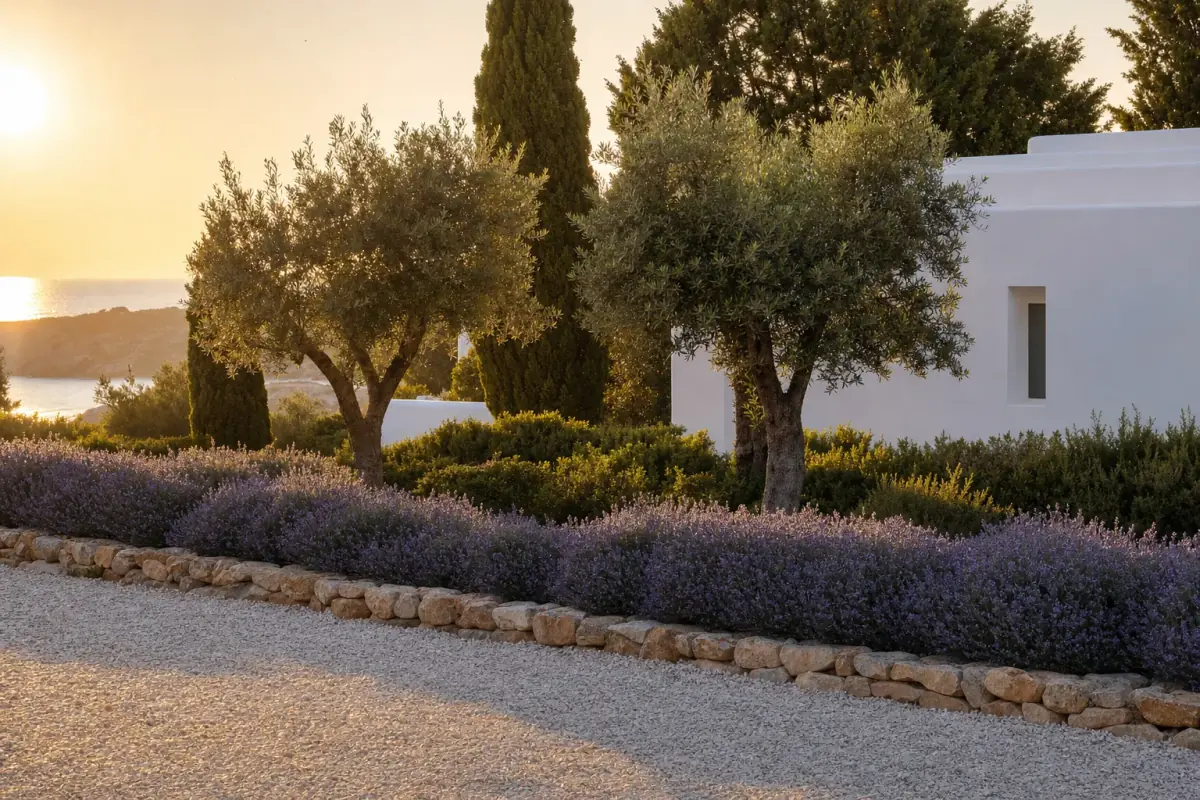
Designing a garden for an Ibiza villa is not a matter of choosing the plants. It is a matter of organising the land so that the climate, the soil, the wind and the water do most of the work for you. A well-designed Mediterranean garden in Ibiza needs roughly one fifth of the water of a temperate garden, looks composed throughout the year, and ages into the landscape rather than fighting it. This guide explains the five-zone framework we use to design gardens for premium villas across the island.
The five functional zones of a Mediterranean villa garden
Rather than thinking in terms of “front garden” and “back garden”, Mediterranean garden design works with concentric functional zones, each with a different relationship to water, sun, traffic and intimacy. Done well, a visitor walks through the garden experiencing distinct atmospheres without ever noticing the design rules behind them.
| Zone | Function | Plant palette | Weekly irrigation | Solar exposure | Wind treatment |
|---|---|---|---|---|---|
| 1. Entrance | Welcome, formal feel, first impression | Cypress, olive, lavender, rosemary | Drip 1×/week | Filtered (pergola optional) | Shielded by villa or wall |
| 2. Leisure / pool | Daily living, pool deck, BBQ | Bougainvillea, oleander, jasmine | Drip 2×/week | Full sun | Wind-protected by hedges |
| 3. Transition | Connects living to wild edge | Cistus, teucrium, santolina | Drip 1×/2 weeks | Open sun | Partial exposure to local breeze |
| 4. Productive | Kitchen garden, citrus, herbs | Lemon, orange, fig, basil, sage | Drip 2-3×/week | Full sun | Sheltered by structure or hedge |
| 5. Contemplative | Wild edge, view framing | Sabina, pine, juniper, native grasses | None after establishment | Full exposure | Wind-resistant species only |
“A Mediterranean garden is not a place where you plant Mediterranean plants. It is a place where the design follows Mediterranean logic: little water, intelligent shade, plants in their right exposure, and a respect for what the local landscape already offers without intervention.”
Mediterranean Garden Society (MGS), design principles handbook
Water: the parameter that organises everything else
Ibiza receives 400-450 mm of rainfall per year, concentrated in autumn and early spring. A traditional lawn-based garden demands 800-1.000 mm. The difference is the gap that imported design fills with constant irrigation, salinity build-up in the soil, and a 30-50 % higher annual water bill. A Mediterranean design closes that gap by choosing species adapted to summer drought, grouping them by water need (hydrozoning), and irrigating each group separately with drip lines.
The result: a garden that survives a Council watering restriction without visible distress, looks lush throughout the season, and reduces water consumption by 60-75 % compared to a non-zoned alternative.
Microclimate: reading the plot before drawing the plan
Two adjacent plots can have entirely different microclimates. A plot facing north-east in San Carlos cools quickly in winter, hosts dew until mid-morning, and supports species that struggle on a south-facing San José plot exposed to relentless afternoon sun. Before any planting, we map four microclimate parameters: solar trajectory throughout the year, dominant winds (Tramuntana from the north in winter, Lebeche from the south-west in summer), water retention by soil type, and proximity to salt-bearing coastal air.
The map drives plant selection. Coastal plots within 500 m of the sea need salt-tolerant species (sabina, juniper, oleander, tamarisk). Plots inland with deeper soil tolerate more demanding species (lemon trees, ornamental hedges, deciduous fruit). This is also why the native Ibiza plant palette we documented elsewhere is so valuable: each species has known performance against each microclimate parameter.
The architectural relationship: garden as extension of villa
A well-designed Mediterranean garden extends the architectural logic of the villa. The same lime-washed walls; the same palette of stone, gravel and earth tones; the same sense of cool retreat. Three principles drive this integration: open sight-lines from key rooms (the dining room should look at a specific tree or vista, not at a hedge); shaded transition zones (pergolas, porches, plant tunnels that move you from house to garden without thermal shock); geometric clarity (lines that respond to the villa’s geometry, not random curves).
This is why the best gardens we deliver are designed at the same time as the villa renovation. When the garden, the landscaping and the architecture share a brief, the result reads as a single coherent project rather than a building with plants around it. For clients of premium landscaping we generally integrate this design at the planning stage of the villa.
Frequently asked questions
Can I redesign an existing garden into a Mediterranean one without removing everything?
Yes, in most cases. We typically keep all mature olive and citrus trees, sometimes carobs and pines, and replace only the high-water elements (lawn, tropical species, exotic palms with high maintenance). Phased transformation across two or three seasons preserves the visual maturity of the garden while shifting the underlying water and labour profile.
How much does Mediterranean garden design cost in Ibiza?
Design fees range from €2.500 to €8.000 depending on plot size and complexity. Implementation runs €40-90 per m² for premium quality including soil preparation, drip irrigation, mature plant material and stone work. A 1.000 m² garden delivered to professional standard typically lands between €50.000 and €90.000 turnkey.
What is the most common mistake in Ibiza garden design?
Underestimating the wind. Many imported designs work beautifully on paper, then collapse the first Tramuntana season because the wind treatment was decorative rather than structural. Proper Mediterranean design treats wind shielding (hedges, windbreaks, micro-topography) as load-bearing infrastructure, not as a planting style.
How long does a Mediterranean garden take to mature?
Three years to look established, five years to look mature, ten years to look as if it has always been there. Specifying larger plant material at installation shortens the first phase but does not collapse the timeline below three years. Plants need to adapt their root systems to the local soil and microclimate before they can express their full character.
Can I have a Mediterranean design with a tropical pool feel?
Yes, around the pool itself. The leisure zone (zone 2 in our framework) tolerates higher-water species used as accents: bougainvillea, oleander, jasmine, banana. The trick is keeping these contained to the pool deck and not letting them bleed into the rest of the garden, where the Mediterranean logic must dominate to keep water consumption realistic.