July 29, 2026
Salt Efflorescence in Ibiza Coastal Walls: How to Identify, Treat and Prevent
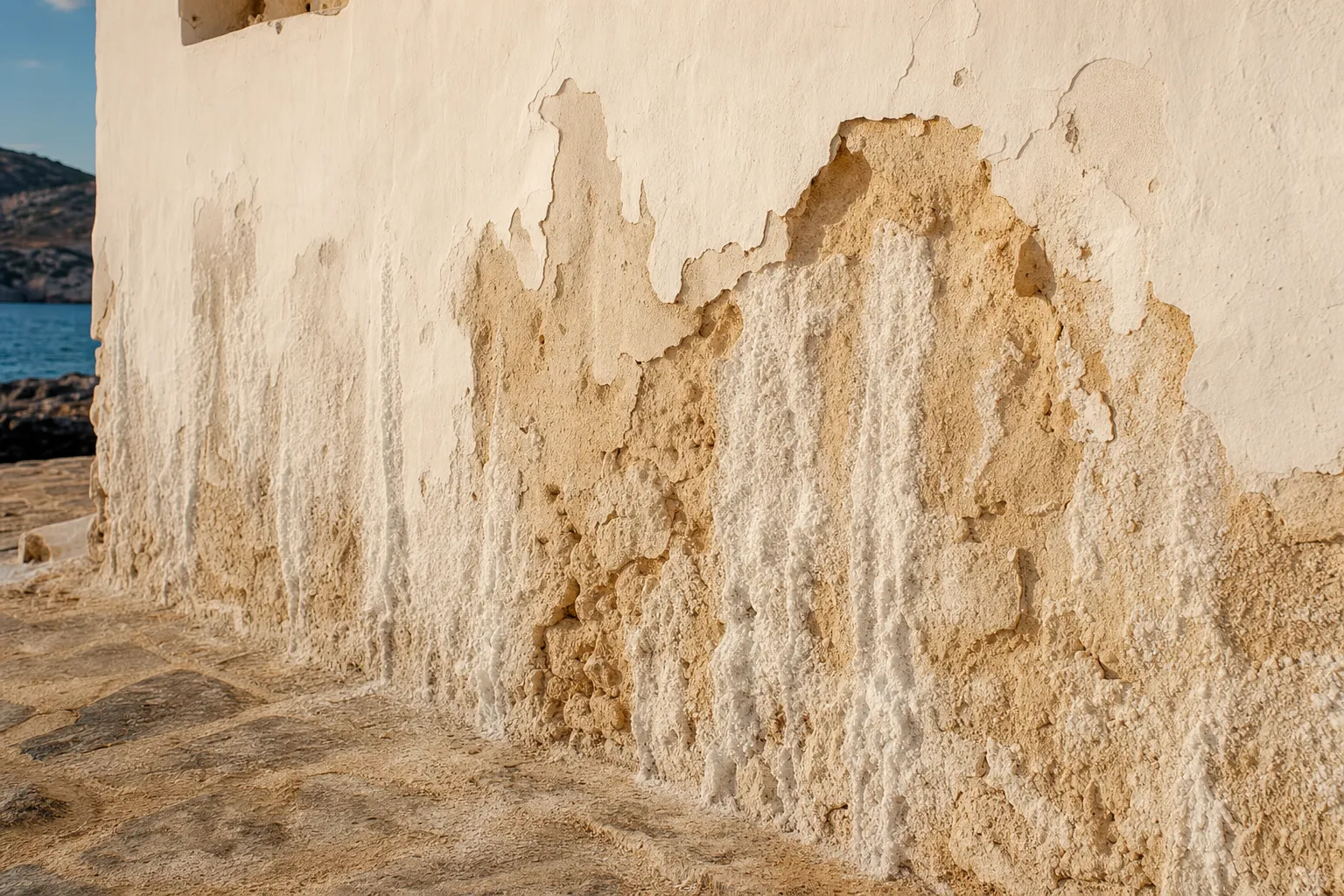
The white blooms on a coastal Ibiza villa wall aren’t just cosmetic; they’re a diagnostic. Salt efflorescence — the crystalline deposits that appear on lower walls, around windows and on rendered facades — is the visible signature of salts migrating through the masonry under humidity cycles. Identifying which salt you’re looking at (and what’s driving its migration) is the difference between an effective treatment and an expensive repaint that fails within two years.
This guide is the diagnostic and treatment playbook: how to identify the three main types of efflorescence on Ibiza coastal walls (carbonates, sulfates, chlorides), what’s behind each one, the treatment that actually works for each, and the prevention strategy that keeps them from coming back. Written for owners of villas within 500 m of the coast — i.e., most premium Ibiza villas.
What efflorescence actually is
Efflorescence is a physical-chemical phenomenon: water-soluble salts dissolve in moisture present within or adjacent to the masonry, migrate to the surface under capillary action, and crystallize as the water evaporates, leaving a visible deposit. The cause isn’t the salt arriving from outside (although in coastal climates it does); the cause is the combination of soluble salts already present in the materials + moisture moving through them.
Three sources of salts dominate on Ibiza walls. From the cement and mortar themselves: calcium and sodium carbonates, sulfates from gypsum. From groundwater rising by capillarity: chlorides (especially in coastal proximity), nitrates from agricultural soil. From the air: chlorides from marine aerosol, particularly within 200 m of the sea.
The three types of efflorescence on coastal walls
| Type | Visible appearance | Origin | Diagnostic test | Recommended treatment | Prevention |
|---|---|---|---|---|---|
| Carbonates (CaCO₃) | Soft white powder, comes off with brushing | From the cement / mortar binder | Disappears under hydrochloric acid (effervescence) | Dry brush, then hydrofuge sealer | Aerial-lime mortar instead of cement; breathable finish |
| Sulfates (gypsum, magnesium sulfate) | Crystalline white blooms, harder to remove | From gypsum-containing materials, groundwater | Doesn’t react with HCl; reacts with barium chloride | Mechanical removal + barrier + mineral paint | Avoid gypsum in damp areas; capillary cut |
| Chlorides (NaCl) | Wet-looking translucent crystals, hygroscopic | Marine aerosol or salt rising from soil | Reacts with silver nitrate (forms white precipitate) | Repeated water wash + breathable hydrofuge | Hydrofuge silane/siloxane coating; capillary cut |
In practice, a chemical lab test on a sample (€80–150) gives definitive identification. Visual inspection is correct about 60% of the time; combined with location (coastal vs inland, ground floor vs upper) it gets to 80%. The remaining 20% justifies the lab cost when treatment specification matters.
“Las eflorescencias salinas son una manifestación visible de procesos físico-químicos en el material de fábrica que requieren diagnóstico antes que tratamiento. Aplicar el producto incorrecto puede empeorar la situación, sellando la humedad en el interior del muro y provocando patologías más graves a medio plazo.”
ITeC — Institut de Tecnologia de la Construcció de Catalunya
Why the wrong treatment makes the problem worse
The most common mistake on Ibiza villa facades is sealing the wall with plastic-based paint or impermeable acrylic to “stop the efflorescence.” It does — for one season. Then the moisture that was previously escaping through the wall builds up behind the impermeable layer, the paint blisters, the salts push it off in larger sheets, and the underlying masonry is in worse condition than before.
The right treatment principle: the wall must be allowed to breathe. Whatever finish goes on a wall that’s had efflorescence must let water vapor pass outward while preventing liquid water from entering. Lime-based paints, mineral silicate paints and breathable silane/siloxane treatments all meet this; plastic paints and acrylics don’t.
The treatment sequence by efflorescence type
Carbonates
Treatment: dry brush the loose deposit (NO water, water dissolves and pushes salts deeper), wait for the wall to fully dry (2–4 weeks in summer, 6–10 weeks in winter), apply a breathable silane/siloxane hydrofuge sealer, then mineral silicate paint as topcoat. Typical lifespan of the result: 8–12 years before the next maintenance cycle.
Sulfates
Sulfates are more aggressive because they recrystallize with volume expansion under humidity cycles, which mechanically damages the masonry. Treatment: mechanical removal of all affected surface mortar (water jet or chiseling), barrier coat (lime-based with sulfate-resistant additives), new lime mortar render, breathable mineral paint. The sulfate source has to be eliminated or the problem returns — usually means addressing capillary rise (capillary cut) and removing any gypsum-containing materials within 30 cm of the affected area.
Chlorides
Hardest to eliminate because chlorides are very soluble and hygroscopic (they absorb humidity from the air). The wall is wet-looking even on dry days. Treatment requires repeated water washes to dissolve and remove salts (poultices help in concentrated areas), drying period, and sealing with a high-quality breathable hydrofuge specifically rated for chloride-rich environments. In coastal Ibiza this is the most common type; treatment cycle 4–6 years if no further protective barrier is in place.
The structural cause: capillary rise and how to cut it
About 70% of efflorescence cases on coastal Ibiza villas trace back to capillary rise: ground moisture entering the wall at the foundation level and migrating upward through the masonry. Treating the surface without cutting the capillary source is repainting in a loop. The capillary cut is what actually breaks the cycle.
- Chemical injection: the most common method. Holes drilled at 10–15 cm spacing along the wall base, filled with hydrophobic silicone-based product that creates a permanent waterproof horizontal barrier. €80–140/m² installed, lifespan 25+ years. Works on most wall types.
- Mechanical insertion: sheet of plastic or metal inserted into a horizontal cut along the wall base. More invasive, more reliable, but only practical on certain wall configurations. €200–350/m².
- Electro-osmosis: a low-voltage electrical field pushes water back down through the wall. Marketed heavily, results mixed. We’ve stopped specifying it after two cases where it didn’t perform.
The capillary cut is the largest single intervention in a serious efflorescence treatment, and it’s where you either solve the problem permanently or set yourself up for another cycle in 5 years. We don’t do efflorescence treatment without first checking whether capillary rise is the underlying cause, regardless of how the visible deposit looks.
How IBOSSIM approaches efflorescence projects
Three protocols. First, diagnosis before treatment. We send a wall sample for chemical analysis if visual identification is ambiguous, measure substrate humidity at three depths (surface, 5 cm, 10 cm), and document the height of the affected zone. This 1–2 day work decides which treatment is right.
Second, root cause before symptom. If the diagnosis indicates capillary rise, the capillary cut goes first, then drying, then surface treatment. Doing surface treatment without capillary cut on a capillary-driven case is throwing money at the wall.
Third, breathable system throughout. The lime mortar, the silicate paint, the hydrofuge sealer are all selected for vapor permeability above a documented threshold. We don’t use any plastic-based or impermeable coatings on walls that have shown efflorescence, regardless of what the previous painter applied. This is the same logic that underlies our broader facade rehabilitation methodology.
FAQ
Can I treat efflorescence myself with a brush and a sealer?
You can remove the visible deposit (dry brush), but unless you’ve identified the salt type and the source, you’ll be brushing again next year. The treatment isn’t expensive in materials; it’s expensive in diagnostic accuracy. DIY makes sense for confirmed carbonates on a wall without capillary rise; not for the typical case.
How long after treatment can I paint the wall?
After capillary cut + treatment: 4–8 weeks of drying before the topcoat. The temptation to paint immediately for aesthetics is strong; resist it. Painting too early seals moisture inside and forces the cycle to repeat.
Is there a treatment that lasts forever?
With proper capillary cut + breathable system, a successful treatment lasts 15–25 years before maintenance is needed. “Forever” doesn’t exist on a coastal wall; the environment is too aggressive. The realistic target is “long enough that the next intervention is part of standard maintenance, not emergency repair.”
Will efflorescence damage the structural integrity of the wall?
Carbonate efflorescence is mostly cosmetic. Sulfate efflorescence (especially under cyclical humidity) can mechanically damage the mortar and stone over years. Chloride efflorescence can corrode embedded reinforcement if water reaches it. Untreated, sulfates and chlorides are not just cosmetic — they’re structural concerns over 10–20 years.
Can I tile or render over an efflorescent wall to hide it?
Yes, and the result fails in 2–4 years. Tiles pop, render cracks. The underlying cause is still active; the finish you put on top just delays the visible symptom while making the eventual repair more expensive.
Salt efflorescence on a coastal Ibiza villa is treatable, with results that last decades — provided the diagnosis comes before the treatment and the root cause is addressed before the surface. If you’re seeing white blooms on the wall, the right first step is a sample analysis and a humidity reading, not a paintbrush.
Request a Diagnostic Wall Inspection
Related reading: The Invisible Shield: How to Protect Your Building · Construction Pathologies in Ibiza · The Best Facade Rehabilitation Techniques.