September 23, 2026
Solar Panel Installation Cost in an Ibiza Villa 2026: Real Pricing per kWp
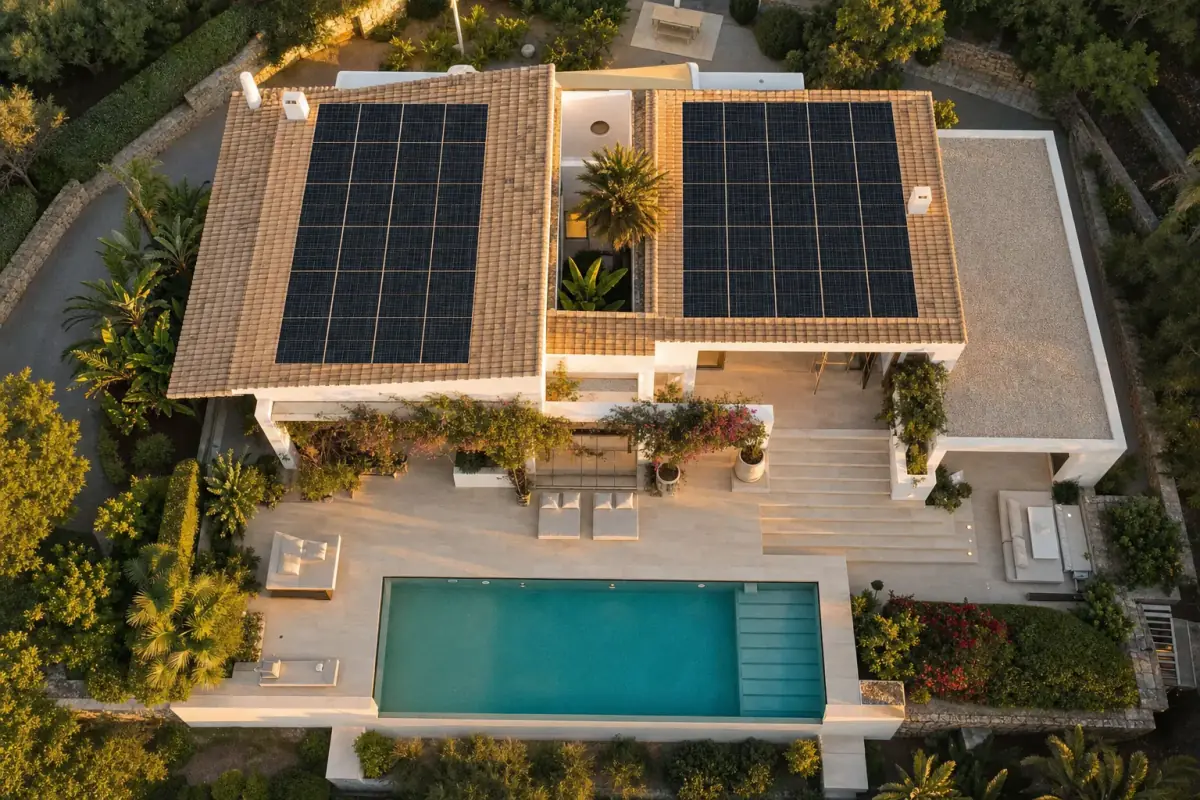
“How much do solar panels cost for my villa?” is the most common question we receive from owners considering photovoltaic installation in Ibiza. The honest answer requires knowing the villa size, electricity consumption, roof orientation, battery preference, and how the system will tie into existing aerothermal or pool equipment. This guide breaks down real 2026 prices for the three typical villa sizes we serve — 200, 400 and 800 m² — with payback calculations using actual Ibiza solar yield and electricity tariffs.
What drives solar PV cost in Ibiza
Six variables determine the final price of a residential photovoltaic installation. System size (kWp) is the headline number. Panel quality: monocrystalline tier-1 (LG, Sunpower, REC) vs polycrystalline budget options. Inverter brand: SMA, Fronius, Huawei deliver 25-year reliability; cheaper inverters fail at 8-10 years. Battery: a 5-10 kWh battery doubles self-consumption but adds €5.000-12.000. Roof type: tile roof installation costs 15-25 % more than sandwich roof. Integration: tying the system into existing aerothermal, pool heating or EV charger adds engineering hours.
Real 2026 pricing for three Ibiza villa sizes
| Villa size | 200 m² | 400 m² | 800 m² |
|---|---|---|---|
| Recommended kWp | 5 kWp | 10 kWp | 18 kWp |
| Number of panels (450 W) | 11 | 22 | 40 |
| Inverter | SMA Sunny Boy 5.0 | SMA Tripower 10.0 | Fronius Symo 17.5 |
| Battery (recommended) | 5 kWh | 10 kWh | 15 kWh |
| Mounting + electrical work | €2.800 | €4.500 | €7.500 |
| Total turnkey cost | €10.500-14.000 | €18.500-25.000 | €32.000-44.000 |
| Annual production (kWh) | 8.000 | 16.000 | 28.500 |
| Annual savings (€) | €1.450 | €2.800 | €4.900 |
| Payback (years) | 7-10 | 6-9 | 6-9 |
“Ibiza receives an average of 2.870 sunlight hours per year, placing it among the highest solar yield regions in Spain. A correctly sized and oriented system on a Pitiusas villa produces 1.500-1.650 kWh per installed kWp — significantly higher than the peninsula average. The economic case for residential solar in the Balearic Islands is stronger than anywhere else in the country.”
UNEF (Unión Española Fotovoltaica), 2026 residential market report
Why villa size matters less than consumption pattern
A 200 m² villa with a heated pool, aerothermal heating, two electric vehicles and year-round occupation consumes more electricity than a 800 m² villa used only in August. Sizing the PV array correctly is about matching production to consumption, not to property size. Three useful benchmarks:
- Low consumption: 4.000-6.000 kWh/year (seasonal villa, no pool heating, gas water heater). 3-4 kWp system, no battery, payback 8-11 years.
- Medium consumption: 8.000-14.000 kWh/year (year-round, aerothermal, pool used in season). 7-10 kWp, optional 5 kWh battery, payback 6-9 years.
- High consumption: 18.000-30.000 kWh/year (year-round, full electrification, heated pool, EV charging). 15-22 kWp, mandatory battery, payback 6-8 years.
Battery: when it actually pays off
A battery is mandatory in two cases and optional in one. Mandatory: when self-consumption needs to exceed 60 % (typical for high-consumption year-round villas where evening electricity demand is high) or when the property is off-grid or has unreliable grid connection (rural northern Ibiza, mostly). Optional: for seasonal villas where self-consumption naturally aligns with solar production (pool, air conditioning, peak daytime use) — the battery adds €6.000-12.000 with marginal benefit.
Battery technology has matured: lithium iron phosphate (LFP) systems from BYD, Pylontech or Huawei last 15+ years with 10.000+ cycles. Avoid older lithium NMC batteries — same upfront price, half the lifespan.
How IBOSSIM approaches solar projects
Our solar projects start with a 12-month electricity consumption analysis: hourly demand pattern, peak load identification, year-round vs seasonal profile. We size the system around real consumption, not theoretical roof capacity. We integrate the system with existing aerothermal heat pumps where present, and design the cable runs to anticipate future EV chargers or pool heating upgrades.
For most premium villa renovations we coordinate solar with sandwich roof rehabilitation, so the installation goes onto a freshly waterproofed substrate with 25-year warranty — see our photovoltaic installation service overview. The total approach connects with our solar boom market analysis and our work on integrating solar with the rest of the home.
Frequently asked questions
Are there subsidies for residential solar in the Balearic Islands?
Residential photovoltaic installations qualify for tax deductions through the autonomous tax (IRPF Balearic deduction up to 50 % of investment, capped at €3.000) and reduced IBI rates in most municipalities. National Next Generation EU subsidies have shifted toward batteries and self-consumption. Check current programmes before committing — they update annually.
How long does the installation take?
From contract signature to commissioning: 6-10 weeks. Permits and bureaucracy: 4-6 weeks. Physical installation: 3-5 working days for the panels, 1-2 days for inverter and battery, 1 day for utility company connection. Most of the timeline is paperwork — the actual technical work is fast.
Can I install panels on a traditional clay tile roof?
Yes, with specific clay-tile-compatible mounting hardware. The installation is 15-25 % more expensive than on sandwich roof or flat roof because each panel attachment point requires a tile-replacement bracket. Worth it if the tile roof is in good condition; otherwise consider full roof rehabilitation alongside the PV install for an integrated 25-year warranty.
What about maintenance?
Minimal. Annual inspection of mounting hardware, electrical connections and inverter logs (€150-250). Panel cleaning every 1-2 years (€80-150). Inverter replacement at 10-15 years (€1.500-3.000). Total lifecycle maintenance is around 5 % of installation cost over 25 years — negligible vs traditional energy systems.
What is the typical 25-year financial outcome?
For a medium-consumption villa with a 10 kWp system: payback at year 7-9, then 16-18 years of net savings totalling €40.000-60.000 (at current electricity prices, more if tariffs rise). The system is paid for itself, then generates pure savings for the rest of its operational life. Internal rate of return typically 9-13 %.