August 5, 2026
Structural Cracks on Old Ibiza Villas: How to Read, Diagnose and Repair Them
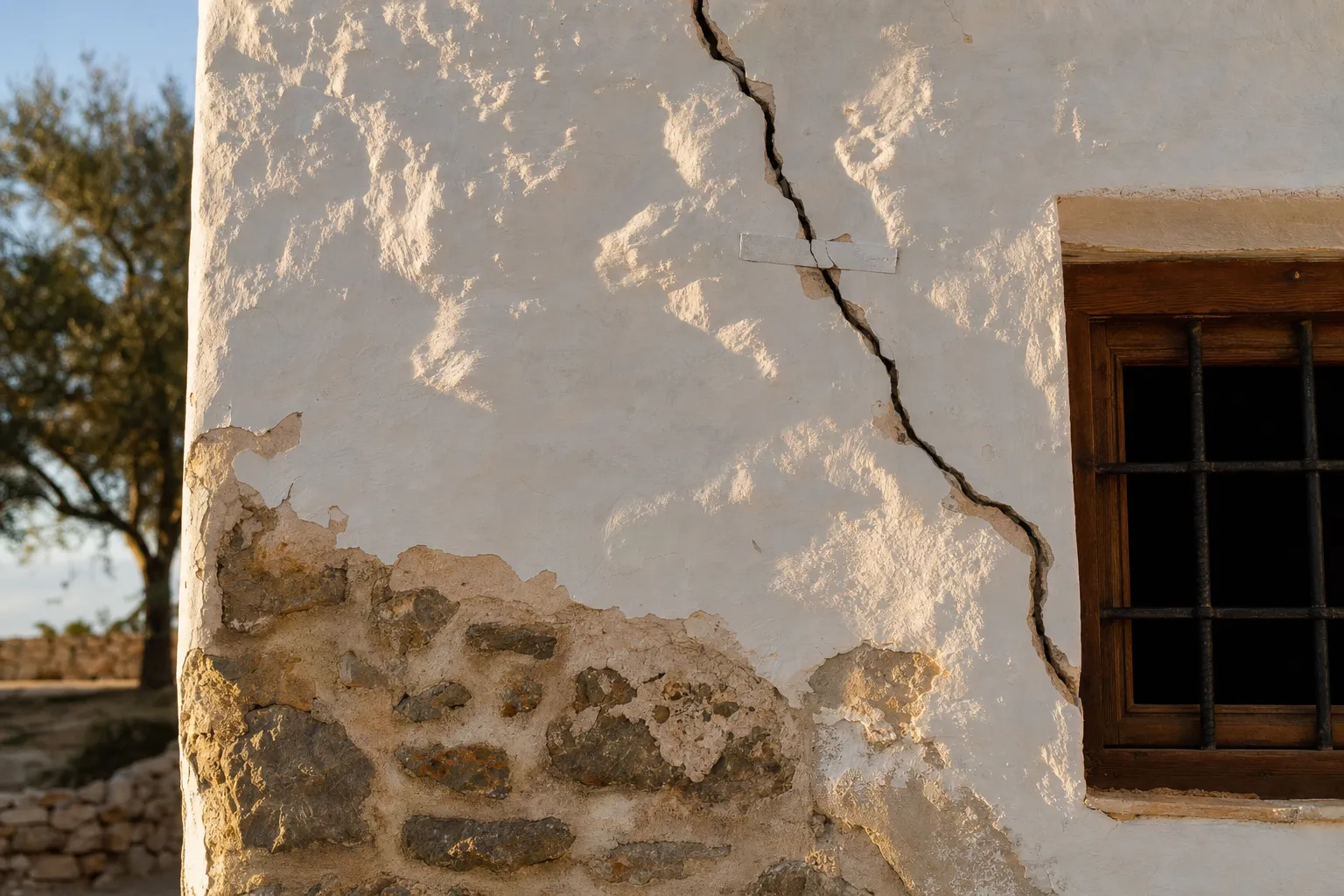
The diagonal crack that appeared above the living-room window two winters ago and looks 2 mm wider now isn’t decoration. It’s a structural conversation between the building and the ground beneath it. Old Ibiza villas — particularly the stone-built ones from before 1980 — develop cracks for predictable reasons, and the difference between cracks you can ignore and cracks that need urgent intervention isn’t the size: it’s the geometry and the rate of change.
This guide is the diagnostic playbook for cracks in old Ibiza villas. How to classify what you’re looking at, how to tell whether it’s still moving, the three families of underlying causes (foundation, structural, thermal/movement), and the proportional repair methods — from gypsum witness strips to full micropile underpinning. Written for owners of pre-1990 villas who’ve seen one or more cracks appear and want to know whether to call an engineer or paint over it.
The four crack patterns and what each one means
Every crack has a shape, a width, a direction and a relationship to the building’s structural geometry. Reading those four variables together is what separates a useful diagnosis from a guess.
| Crack pattern | Typical width | Severity | Probable cause | Repair method | Professional needed |
|---|---|---|---|---|---|
| Hairline vertical (interior plaster) | <0.3 mm | Cosmetic | Plaster shrinkage, finish layer only | Filler + repaint | Painter |
| Diagonal from window/door corner | 1–4 mm | Structural — moderate | Foundation settlement OR thermal movement of opening | Witness monitoring, then injection or stitching | Structural engineer |
| Horizontal along masonry course | 2–8 mm | Structural — high | Lateral pressure, slab disconnection, or shear failure | Reinforcement + tie-back, partial rebuild if severe | Structural engineer + builder |
| Branched / tree-like spreading | Variable | Structural — critical | Active foundation movement, multiple stress points | Underpinning + structural reinforcement | Engineer + specialist contractor |
| Step crack along mortar joints | 1–5 mm | Structural — high | Differential settlement | Underpinning + mortar repointing | Engineer + traditional masonry |
| Wide gap at wall-floor junction | 3–10 mm+ | Critical (urgent) | Foundation rotation or major settlement | Immediate engineer call | Urgent structural assessment |
Two patterns deserve immediate attention: the branched/tree-like spread and the wide wall-floor gap. Both indicate active or recent movement. The other patterns can usually be observed for a few months (with proper monitoring) before deciding on the intervention scale.
“La grieta es un síntoma, no un diagnóstico. Antes de cualquier reparación, el técnico tiene que entender qué está pasando bajo el muro o dentro de él. Pintar encima de una grieta activa — la solución más habitual en obras hechas por no-especialistas — convierte un problema visible en un problema oculto que reaparece años después con daños mayores.”
COAIB — Colegio Oficial de Arquitectos de las Illes Balears
The witness test: how to know if a crack is still moving
A crack that’s no longer growing is a problem that’s already happened. A crack that’s still growing is a problem you’re still inside. The way to tell which one you have is the witness strip — a low-tech but reliable technique used since the 19th century, still standard in modern structural engineering.
- Gypsum strip: a thin band of gypsum or plaster applied across the crack at 90°, with a date written on it. If the strip cracks or moves over the following 3–6 months, the underlying crack is still active. If the strip remains intact, the movement has stopped.
- Calliper readings: three reference points marked across the crack with permanent pen or stickers, measured monthly with a digital calliper. Reveals sub-millimeter movement that’s invisible to the eye.
- Telescopic crack meters: for serious cases, a mechanical or digital crack meter installed across the crack measures displacement to 0.01 mm precision. Used by structural engineers when underpinning is being considered.
For a typical Ibiza villa crack, a gypsum strip with a date written on it, observed for 4–6 months, gives an answer for free. Combine with photographic record from a fixed position and you have a useful evidence base for the structural engineer when (if) they’re called.
The three causes behind most Ibiza villa cracks
1. Foundation settlement
The single most common cause on older Ibiza villas. Foundations built before modern soil-mechanics standards, in calcareous soils that compact or wash under groundwater changes. Cracks appear at building corners, propagate diagonally from openings, and follow the geometry of the underlying settlement. Repair: micropile underpinning, which stabilizes the foundation at 8–15 m depth and stops further movement. Cost: €25,000–80,000 depending on extent.
2. Thermal and seasonal movement
Less serious. The wall expands and contracts with daily and seasonal temperature swings. Cracks appear at openings (windows, doors), along finish interfaces, and where dissimilar materials meet. Movement is cyclical — the crack opens and closes. Repair: flexible injection fillers (polyurethane resin) that accommodate the cyclical movement instead of rigid mortar that re-cracks within a year.
3. Structural overload or modification
Less common but important. A previous owner removed a load-bearing wall without proper reinforcement, added a heavy roof terrace on an undersized slab, or built an extension whose loads exceed the original structure’s design. Repair: engineering analysis followed by targeted structural reinforcement (steel beams, helical anchors, partial rebuild). Cost varies enormously: €15,000–200,000+.
Repair methods proportional to the diagnosis
Cracks aren’t a single problem; the repair shouldn’t be a single method. Match the intervention to the severity, the cause and whether the movement is ongoing.
- Cosmetic filler + repaint: only for confirmed-static hairline cracks in the finish layer. Cost: €100–400 per crack. Lifespan: indefinite if the crack is truly cosmetic.
- Epoxy resin injection: for non-moving structural cracks in masonry. Restores monolithic behavior. Cost: €40–80 per linear meter. Lifespan: 20+ years.
- Stitching with helical bars: for cracks in stone masonry walls. Stainless steel helical bars embedded across the crack at intervals re-tie the wall. Cost: €60–120 per linear meter. Lifespan: equivalent to original structure.
- Stitching + polyurethane injection (combined): for cracks with both lateral and through-thickness components. The combination is what we use most often on Ibiza stone villas.
- Micropile underpinning: for confirmed foundation settlement causing ongoing cracking. Drilled piles at 8–15 m depth tie the foundation to load-bearing strata. Stops movement permanently. Cost: €25,000–80,000.
- Steel beam reinforcement / partial rebuild: for overload or removed load-bearing elements. Reinstates structural integrity. Cost: €15,000–60,000 per intervention.
How IBOSSIM approaches a cracks project
Three protocols. First, never start repair without a structural engineer’s report on a crack wider than 1 mm in load-bearing masonry. The cost of the report (€800–2,500) is dwarfed by the cost of a repair that doesn’t address the real cause. We’ve seen Ibiza villas where €40,000 of repair was applied to a problem whose real solution was €25,000 of underpinning — and the original cracks reappeared within 18 months.
Second, witness monitoring before commitment. Where the engineer’s first reading is ambiguous, we install witness strips and meters and wait 3–6 months before defining the repair scope. The cost of waiting is small; the cost of premature intervention is large.
Third, integration with broader villa pathology. Cracks rarely come alone — the same building movement that produced the crack also affects the waterproofing, the carpentry, the roof. We assess them together. This is consistent with our broader work on construction pathologies in Ibiza: the symptoms link to the same underlying causes more often than not.
FAQ
How urgent is a 2 mm diagonal crack from a window corner?
Moderately. It needs witness monitoring (gypsum strip) for 3–6 months. If the strip stays intact, the movement has stopped — repair can be planned as a non-urgent intervention. If it cracks, structural engineer’s call within weeks.
Can I sell the villa with unresolved cracks?
Technically yes, with disclosure. The price discount for unresolved structural cracks ranges from 5% (well-documented monitored cracks) to 20%+ (unexplained spreading cracks). Resolving them before sale is usually a strong ROI move.
Do cracks affect home insurance?
Yes. Insurers ask about visible structural damage at policy renewal. Unresolved cracks can increase premiums or exclude structural cover entirely. Documenting the repair (engineer’s certificate, contractor’s invoice) keeps cover intact.
Are cracks more common in stone villas vs concrete villas?
More common in old stone villas, but more dangerous in concrete villas. Stone walls develop visible cracks slowly and tolerate movement better; concrete cracks tend to be smaller but indicate more serious internal damage (rebar corrosion, brittle failure). Both deserve professional assessment.
How long does crack repair take?
Cosmetic repair: 1–2 days. Injection + stitching: 1–2 weeks. Underpinning: 4–10 weeks. Major reinforcement: 6–16 weeks. Most projects are scheduled for off-season (October–April) to minimize disruption.
Structural cracks in old Ibiza villas are treatable, and the right intervention lasts as long as the rest of the building. The decision tree starts with diagnosis, not with picking a repair method. If you’ve seen a crack widen over recent months — or one appear where there wasn’t one — the right first step is an engineer’s inspection and a witness strip.
Request a Structural Inspection
Related reading: Construction Pathologies in Ibiza · Transforming a Traditional Finca into a Modern Paradise.