November 11, 2026
Mortex in Bathrooms and Showers: Premium Interior Applications in Ibiza Villas
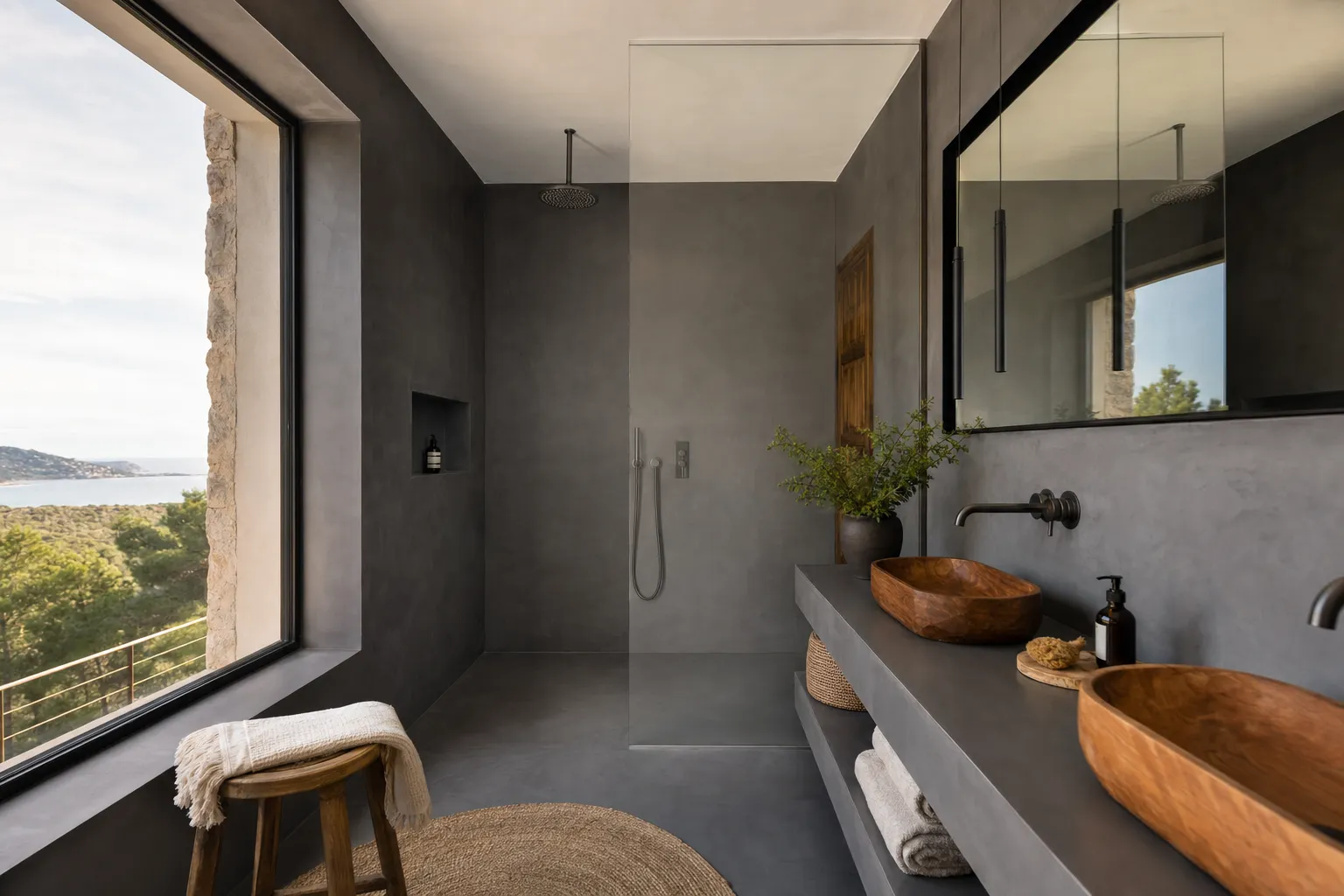
Mortex is the material premium villa architects on the island reach for when they want a bathroom that reads as one continuous surface: walls, floor, vanity and shower bench, all in the same warm grey, with no grout lines to interrupt the eye. The result is unmistakably Mediterranean and, when correctly executed, surprisingly durable. The trap is that the same product, applied with the wrong substrate preparation or the wrong sealer, fails early and very visibly. This guide explains how Mortex really works in Ibiza interiors, how it is quoted, where it shines and where it does not belong.
What Mortex actually is
Mortex is a continuous, hand-applied mineral coating. Its base is lime and natural stone (lime with fine mineral aggregates of marble and stone); it is pigmented through, applied in several thin coats and finished with a penetrating seal. The result is a thin, monolithic surface that is waterproof, slip-resistant with the right finish, and ages the way natural stone does, slowly developing a patina that most owners prefer to the day-one look.
It is not microcement, although the two are often confused. Microcement is a broader category of cement-based coatings with resins and polymers; Mortex is formulated with lime and natural stone. That difference in composition is why Mortex performs better in areas that get wet every day, such as showers and built-in trays, while microcement relies more on the sealer applied afterwards. We cover it in detail in our mortex vs microcement comparison.
Mortex applications by surface in a luxury Ibiza bathroom
| Surface | Finish | Seal | Maintenance | Aesthetic strength | Limitations |
|---|---|---|---|---|---|
| Shower walls and floor | Smooth, soft sheen | Several penetrating coats plus a sacrificial coat | Neutral soap and regular re-waxing | Continuous wet area, no grout | Falls to the drain essential, drain detail critical |
| Bathroom floor (dry) | Matte, lightly textured | Penetrating coats plus a matte topcoat | Neutral soap and a periodic deep clean | Continuous with the shower, warm underfoot | Avoid highly acidic spills |
| Vanity countertop | Smooth to satin | Food-safe seal plus wax | Regular waxing, no harsh cleaners | Sculptural integrated basin possible | Very hot objects damage the finish |
| Bathroom wall (dry) | Light texture or smooth | Penetrating coats | Damp cloth and occasional wax | Tonal continuity with the floor | Repairs can show if damage occurs |
Each surface needs its own finish and its own seal. The shower needs the most protection, the dry wall the least. Specifying one system for everything is among the most common mistakes we see.
The colour palette that works in Mediterranean light
Mortex comes in a wide range of standard colours and can be custom-pigmented. Not every tone works in the strong Ibizan light. Warm greys (anthracite, taupe, dove) are the most requested in premium villa work and cope very well with the way light shifts through the day. Soft whites and creams evoke the traditional whitewashed Ibizan wall and sit beautifully with sabina wood and lime renders, but show dust and water spots more than darker tones. Saturated terracotta and ochre work in specific Mediterranean-rustic settings but tend to date sooner and are hard to update. Deep navy, black or charcoal create dramatic, spa-like spaces but absorb noticeably more solar heat than lighter tones, a real consideration in south-facing bathrooms with natural light.
In our recent projects, the combination we repeat most is anthracite grey for walk-in showers, soft taupe for floors and a darker contrasting tone on a single accent wall. It ages gracefully and never fights with the architecture of a traditional Ibizan villa.
The substrate preparation that determines success
Mortex fails when the substrate fails. The product is not a waterproof miracle: it is a finish that, applied over a properly waterproofed and structurally stable substrate, integrates that waterproofing into a beautiful surface. The critical substrate steps are:
- Structural soundness verified by tapping, with no hollow or loose areas.
- A dedicated waterproofing membrane under the Mortex in wet areas. Mortex adds water resistance, but in showers it is not the primary waterproof layer.
- A dry substrate: moisture is measured before application, and work only goes ahead once it is within the manufacturer’s requirements.
- Mechanical preparation of glazed surfaces, sanding or shot-blasting existing tile if applying over it.
- The right primer, with a different formulation for absorbent and non-absorbent substrates.
- Stable ambient conditions during application and curing, avoiding extremes of cold or heat and respecting drying times between coats.
Cut any of these corners and problems appear before long: detachment from the substrate, micro-cracking at drainage points, dark patches from moisture behind, or visible discolouration in heavy-use areas. The product itself almost never fails; the system around it does.
Quotation and timeline in Ibiza bathroom work
We do not publish indicative prices: every bathroom is quoted after a site visit, based on surface area, substrate and finish. The condition of the substrate, any waterproofing that needs resolving underneath, how far the Mortex extends (shower only, the whole bathroom, or a suite including the vanity) and the chosen finish all change the figure considerably, which is why we prefer to see the property before putting a number on it.
The timeline depends on the bathroom too. The sequence is always the same: substrate preparation, the Mortex coats with curing in between, the seal in several coats and, finally, waxing and inspection. What you should never do is compress curing times to save days, because that is exactly what causes the failures described above. The bathroom cannot be used during the works or during the final cure after sealing; we set the exact schedule when we quote.
Where Mortex does not belong
Not every premium project benefits from Mortex. Heavy-traffic kitchen floors need harder surfaces such as porcelain or natural stone. Outdoor terraces exposed to frost (rare in Ibiza) can crack the finish. Pools with frequent, aggressive chemical treatment need specific formulations or specialised alternatives; see our pool waterproofing guide. Surfaces likely to see hot pans, oils or acids (informal kitchens, garage workshops) are the wrong application. Wet areas over plywood or timber substrates without dedicated structural backing fail at the flex points.
Maintenance that extends the life of Mortex
Mortex needs less maintenance than its appearance suggests, but what it does need is specific:
- Daily: neutral pH soap only. No acidic cleaners (descalers, hydrochloric acid) and no abrasive pads.
- Weekly: in shower and bath areas, dry the surface to avoid water spots on lighter tones.
- Monthly: a thin coat of protective wax on countertops and high-touch areas.
- Annually: a deep clean with a cleaner suited to the coating, a check for micro-cracks and fresh wax on every surface.
- Periodically: renew the top coat of sealer when wear calls for it.
With that discipline, Mortex is a long-lasting finish that gains character over time instead of losing it.
How IBOSSIM specifies and installs Mortex
We work with applicators who specialise in Mortex, document the substrate preparation with dated photographs and check substrate moisture before each coat. At handover we give owners a maintenance kit (the right soap, protective wax, application instructions), and we offer an optional annual maintenance contract that keeps the surface looking its best.
To fit it into a wider renovation, see our kitchen renovation guide and the pool waterproofing approach, where Mortex works under different conditions.
Frequently asked questions
Can Mortex be applied over existing tile?
Yes, with proper preparation. Existing glazed tile needs mechanical roughening (sanding or shot-blasting) and a specific bonding primer. Loose or hollow tile must be removed and re-bedded first. Done correctly, the result is indistinguishable from a new substrate. Done in a hurry, the grout lines underneath end up showing through the Mortex.
How does Mortex compare to large-format porcelain tile?
The appearance is fundamentally different: Mortex reads as a hand-applied artisanal finish, porcelain as a manufactured material, and Mortex has no joints at all. On cost there is no general answer: each case is quoted after a site visit, based on surface area, substrate and finish. Owners who choose Mortex usually do so for its unique look and the continuity of the surface.
Does Mortex stain from soap, oil or hair products?
Well-sealed, waxed Mortex resists most household stains. Persistent oils (hair products especially) can mark lighter colours if they are not wiped promptly; darker tones hide them far better. Periodic deep cleaning and re-waxing restore the finish’s resistance.
What happens if Mortex chips or cracks?
Small chips and hairline cracks are repaired with the original Mortex mix kept at handover; the repair shows at first and blends in over time as the patina evens out. Larger cracks or detachment need professional repair: removing the affected area, re-preparing the substrate and applying fresh Mortex. On light colours the repair is rarely invisible; on dark ones it usually is.
Is Mortex a good choice for a holiday rental villa?
Yes, with conditions. It gives a distinctive finish and its maintenance is simple, as long as it is respected: pH-neutral products only and no harsh chemicals. The cleaning service needs to know that routine, ideally backed by a maintenance contract. Bathrooms used by guests need re-waxing at least once a year. Without that care, the finish wears faster than in an owner-occupied home.