September 16, 2026
Outdoor Lighting Design for Premium Ibiza Gardens: Layers, Tech and Light Pollution
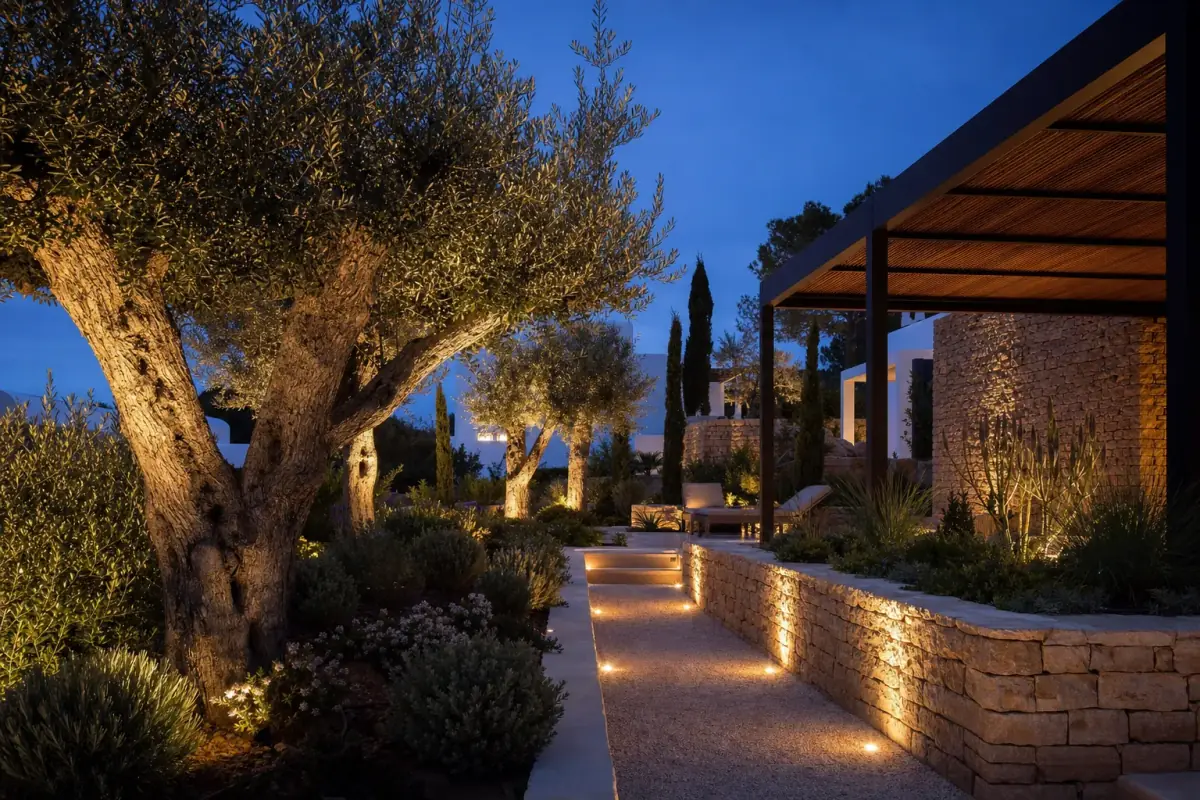
Outdoor lighting decides whether an Ibiza villa garden disappears at sunset or becomes the highlight of every dinner. Done well, it adds two extra hours of usable space, frames the architecture more dramatically than daylight ever does, and increases perceived property value disproportionate to its cost. Done badly, it creates glare on the dining table, washes the pool deck in cold supermarket light, and contributes to the very light pollution that the Balearic Cel Fosc regulation is trying to control. This guide explains the four-layer approach we use for premium gardens on the island.
The four lighting layers in a premium garden
Single-layer outdoor lighting (a few floodlights pointing at the trees) is what makes most villa gardens look like petrol stations after dark. A professional design uses four overlapping layers, each switchable independently, each calibrated to a specific colour temperature and intensity, each respecting the dark-sky framework that Cel Fosc and the Consell Insular have established for the island.
| Layer | Lamp type | Lumens / unit | Colour temp (K) | IP rating | Consumption / unit | Reference brand |
|---|---|---|---|---|---|---|
| 1. Ambient | Bollard, wall sconce | 200-500 | 2.700 K | IP65 | 5-9 W LED | Bega, Davide Groppi, Ares |
| 2. Functional | Path light, step light | 100-250 | 3.000 K | IP67 | 3-5 W LED | iGuzzini, Hess, Erco |
| 3. Accent | Tree uplight, wall wash | 400-1.200 | 2.200-2.700 K | IP66-67 | 7-15 W LED | Lucenti, Targetti, iGuzzini |
| 4. Security | PIR floodlight, perimeter | 1.200-3.000 | 4.000 K | IP65 | 15-30 W LED | Lutec, Steinel, Bega |
“In the Mediterranean nightscape, less is dramatically more. A garden lit with restraint, with luminaires properly shielded and colour temperatures below 3.000 K, delivers visual impact while preserving the night sky. Over-lighting destroys both the design and the dark-sky environment that the Balearic Islands legally protect.”
Cel Fosc — Asociación contra la Contaminación Lumínica, premium installation guide
The colour temperature decision (most underestimated parameter)
Colour temperature, measured in Kelvin, decides whether a garden looks like a five-star resort (2.200-2.700 K warm amber) or a parking lot (4.000-6.500 K cold white). Mediterranean outdoor lighting almost always sits at 2.200-2.700 K — the same warmth as a fire or candlelight. Cooler temperatures should only appear in security applications where high colour rendering for surveillance cameras matters.
The second underestimated parameter is the CRI (colour rendering index). Cheap LED fixtures have CRI 70 or below, which makes foliage look grey and stone look flat. Premium fixtures specify CRI 90+, which preserves the colour of the olive bark, the blush of bougainvillea, the warmth of limestone. The difference is dramatic and not negotiable in a premium project.
The light-pollution dimension: complying with Balearic regulation
Balearic Islands law (Llei 3/2005 against light pollution, Decret 4/2016) establishes zones with maximum upward light flux. Much of inland Ibiza falls in zones E1-E2, where uplighting and unshielded fixtures are explicitly restricted. Premium installations comply through three techniques: full cut-off luminaires (no light above horizontal), downlighting from above rather than uplighting from below, and colour temperatures below 3.000 K (cool blue light is the main contributor to skyglow).
The unexpected benefit: regulation-compliant gardens look more atmospheric, not less. Cut-off fixtures eliminate glare. Warm light flatters mediterranean materials. And the visible night sky becomes part of the experience — which is rare and increasingly valuable on a Mediterranean island.
Power, control and integration with the villa
A premium villa garden lighting installation runs on 12V or 24V low-voltage circuits, with the transformer hidden in a technical area and DALI or KNX control integrated with the villa’s smart system. This allows scene control (dinner, party, security, off) from the same wall plate or app that controls the interior. For pool integration, low-voltage RGBW LED systems with marine-grade IP68 rating add a dynamic colour layer that can be programmed to subtle changes rather than rainbow chaos.
The full design integrates with the rest of the garden infrastructure — drip irrigation, audio, possibly heating — through a shared trench plan executed once. This is why we always recommend designing the lighting in parallel with the garden design and the maintenance plan, never as an afterthought. Smart-home integration is documented in our smart-home trends analysis.
Frequently asked questions
How much does premium outdoor lighting cost in Ibiza?
A complete four-layer installation for a 1.000 m² garden, including premium fixtures, transformers, control system and integration, runs €18.000-35.000 turnkey. About 60 % is fixtures, 25 % installation labour and trenching, 15 % control system. Excellent ROI: a well-lit garden is reported by owners as one of the highest-value-per-euro improvements they make to a villa.
Can I retrofit lighting into an existing garden?
Yes, but the trenching disturbance is the main constraint. Retrofitting through a mature garden costs 30-50 % more than installing during construction because of careful manual trenching around established roots. For owners considering a future renovation, integrating lighting design at that stage saves significantly.
What is the typical lifespan of premium LED outdoor fixtures?
Industrial-grade outdoor LED fixtures with stainless steel or anodised aluminium housing last 50.000-80.000 hours of operation, equivalent to 15-25 years of typical garden use. Drivers and transformers may need replacement at 8-12 years. Cheap consumer-grade fixtures last 2-4 years in coastal conditions before salt corrosion destroys them — a false economy.
Is solar-powered outdoor lighting a viable option?
For premium villas, no. Solar fixtures have unreliable output across winter, battery life of 2-4 years, and incompatibility with multi-layer scene control. They make sense for non-critical accent lighting in remote areas of large estates where wiring is impractical. For the main garden, wired low-voltage systems are non-negotiable for quality.
How do I avoid attracting insects to the dining area?
Two strategies. First: use 2.200 K (very warm amber) at the dining area, since blue wavelengths attract most insects, and 2.200 K emits very little blue. Second: place the brighter accent layer fixtures 5-8 m away from the dining area, drawing insect activity away from where people are. Combined, these reduce dining-area insect activity by roughly 70 %.