August 19, 2026
Traditional Ibizan Construction: How the System Works and Why Modern Renovations Break It
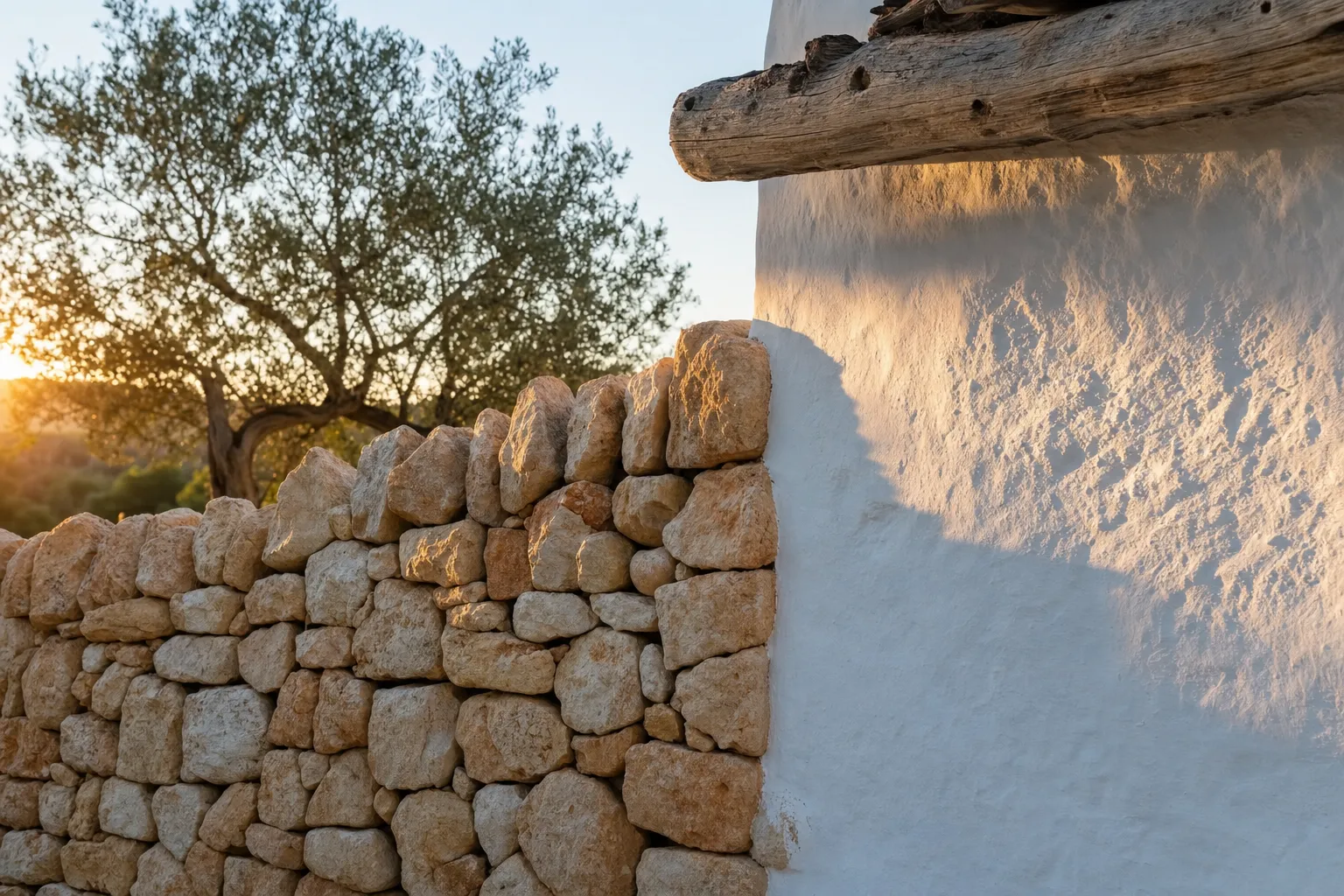
Traditional Ibizan construction — the so-called arquitectura payesa — is not just an aesthetic preference. It is a technical system refined across five centuries: load-bearing stone walls 50-70 cm thick, sabina wood beams, flat clay-and-lime roofs, lime-washed exteriors. Each element solves a specific Mediterranean problem: thermal mass against summer heat, breathability against winter humidity, durability against the Tramuntana. This guide explains how the system works, why so many modern renovations break it, and how a contemporary villa can integrate the traditional logic without sacrificing comfort.
The five pillars of Ibizan vernacular construction
Authentic casa payesa architecture rests on five interlocking technical decisions. Each makes the others work; remove one and the system starts to fail. We see the consequences regularly in villas renovated by teams unfamiliar with the local logic.
- Load-bearing stone walls (50-70 cm). Limestone or sandstone laid in lime mortar, with thermal mass that absorbs daytime heat and releases it slowly at night. They keep interiors 6-10 °C below outdoor peak temperature without mechanical cooling.
- Sabina wood structure. Sabina (Juniperus phoenicea) is naturally resistant to insects, rot and the salt air. Traditional roof beams are exposed sabina, often visible from the interior — both decorative and structural.
- Flat clay-and-lime roofs. A composite of algas posidonia, lime mortar and clay tiles. Heavier than modern roofs, but with massive thermal inertia and natural waterproofing when properly maintained.
- Whitewashed lime façades. Lime is breathable, antiseptic and reflects 80-90 % of solar radiation. Modern acrylic paints suffocate the wall and trap moisture — a leading cause of facade pathologies in renovated villas.
- Small openings, oriented south. Traditional houses have few and small windows, mostly south-facing for winter light, with thick lintels (now often jambs of fissure problems — see our guide to structural cracks).
Where modern renovations break the traditional logic
The most common mistake we see in finca renovations done by non-local teams: treating the building as if it were modern concrete construction. The consequences are predictable.
| Modern intervention | Why it breaks the system | Consequence within 5-10 years |
|---|---|---|
| Acrylic exterior paint over lime walls | Blocks vapour migration outward | Salt efflorescence, paint peeling, internal damp |
| Cement render replacing lime mortar joints | Rigid; cracks under thermal cycles | Hairline cracks expanding to structural fissures |
| Modern bituminous roof membrane over traditional flat roof | Eliminates breathability; traps condensation | Sabina beams rot from above |
| Large unglazed openings facing west or south | Excessive solar gain | Cooling load triples, comfort drops |
| Internal cavity wall insulation glued to stone | Dew point moves inward of wall mass | Mould behind insulation, hidden moisture damage |
“Ibizan vernacular architecture is not a stylistic relic but a passive climatic system optimised over five hundred years. Renovation strategies that ignore the breathability, thermal mass and lime-based interfaces of the original building introduce pathologies that did not exist before the intervention.”
Consell Insular de Eivissa, Pla Territorial Insular 2024 — annexes on rural heritage
How to renovate traditionally without going backwards in comfort
The good news: it is entirely possible to renovate a traditional Ibizan villa to 2026 comfort standards — air conditioning, underfloor heating, smart lighting, energy-A certificate — without breaking the traditional system. The trick is materials and details, not technology.
Stay breathable. Replace cement renders with hydraulic lime mortar. Use mineral silicate paints instead of acrylic. Specify breathable insulation (wood fibre, hemp, cork) instead of impermeable foams. Keep the thermal mass. Resist the temptation to thin the stone walls; their inertia is the cooling system. Add mechanical comfort discretely. Aerothermal heat pumps with underfloor heating, hidden ducted air conditioning, ceiling fans — none of which require modifying the structural envelope. Use traditional materials in contemporary detailing. Sabina beams can be exposed in new construction; lime walls can host modern lighting; whitewashed exteriors can be combined with steel-framed terraces.
The materials that work in Ibiza (and the ones to avoid)
Decades of building on the island have produced a clear hierarchy of materials. The ones at the top last 50+ years with minimal maintenance; the ones at the bottom create problems within 5.
- Excellent: local limestone, sabina wood, hydraulic lime, lime wash, ceramic clay tile, hemp insulation, cork board.
- Acceptable with care: reinforced concrete (only when properly insulated), modern aluminium-clad timber windows, mineral silicate paints, breathable membranes.
- Problematic in coastal/rural Ibiza: acrylic paints, cement renders on old stone, bituminous waterproofing on flat roofs, gypsum boards in humid zones, polystyrene insulation on exterior walls.
For the specific challenge of waterproofing a traditional flat roof, the right answer is rarely a modern bituminous membrane: lime-based traditional waterproofing, properly maintained, outperforms the modern alternative in this specific context.
How IBOSSIM approaches traditional renovations
We work with three local resources that most non-island teams cannot access: a lime quarry in the Pitiusas with documented mineralogical composition, sabina suppliers that comply with sustainable forestry from Formentera, and local craftsmen — the few remaining oficios of payés masonry. Combining those with modern detailing is what allows us to deliver a villa that feels Ibizan, lasts five decades, and meets contemporary energy certificates.
In recent years we have applied this methodology in multiple projects, including the integral transformation of a traditional finca into a modern villa, where the original 1850 stone shell was preserved and reinforced while modern systems were threaded through it. The result reads as authentic Ibizan architecture from the road, and lives as a contemporary villa from inside.
Frequently asked questions
Is traditional Ibizan construction stronger than modern concrete?
For its specific function — Mediterranean climate, low seismic activity, modest loads — yes. Stone walls 60 cm thick with lime mortar have superior thermal performance, longer lifespan and lower lifecycle environmental impact than equivalent concrete construction. Concrete wins on speed of execution and engineering flexibility for unusual geometries, not on durability.
Can I add modern elements to a traditional villa?
Yes, with two rules. First: any addition that touches the original structure must respect its breathability (no cement against lime walls, no impermeable membranes on flat roofs). Second: any visible modern element should be contemporary in language, not pretending to be traditional. The worst results we see come from cheap “rustic” pastiche; the best from confidently modern interventions framed by the original payés shell.
Does traditional construction need protection from the Tramuntana?
Traditional houses were designed against the Tramuntana from the start. Small openings, north walls without windows, dense vegetation belts of carob and pine on the windward side, and stone roofs that resist suction loads. Modern additions — glazed terraces, oversized openings, light roofs — frequently break that logic and require engineering compensation: structural wind anchoring, laminated glass, reinforced flat roofs.
Are traditional materials more expensive than modern ones?
In materials alone, hydraulic lime and quality sabina cost 20-40 % more than the modern alternatives. In labour, traditional execution adds 15-25 % more hours. In lifecycle (including maintenance, repairs and replacement), the traditional system is cheaper over a 30-year horizon by a clear margin. The premium is real upfront, the saving real over time.
Can I build new construction in traditional style on rustic land?
Yes, and the Pla Territorial Insular actually rewards it: new construction that respects traditional volumetry, materials and proportions often qualifies for higher buildable allowances and faster approval than non-traditional designs. Working with an architect who understands both the heritage rules and the contemporary brief is the differentiator.