September 30, 2026
How to Choose a Reliable Solar Installer in Ibiza: 8 Filter Criteria
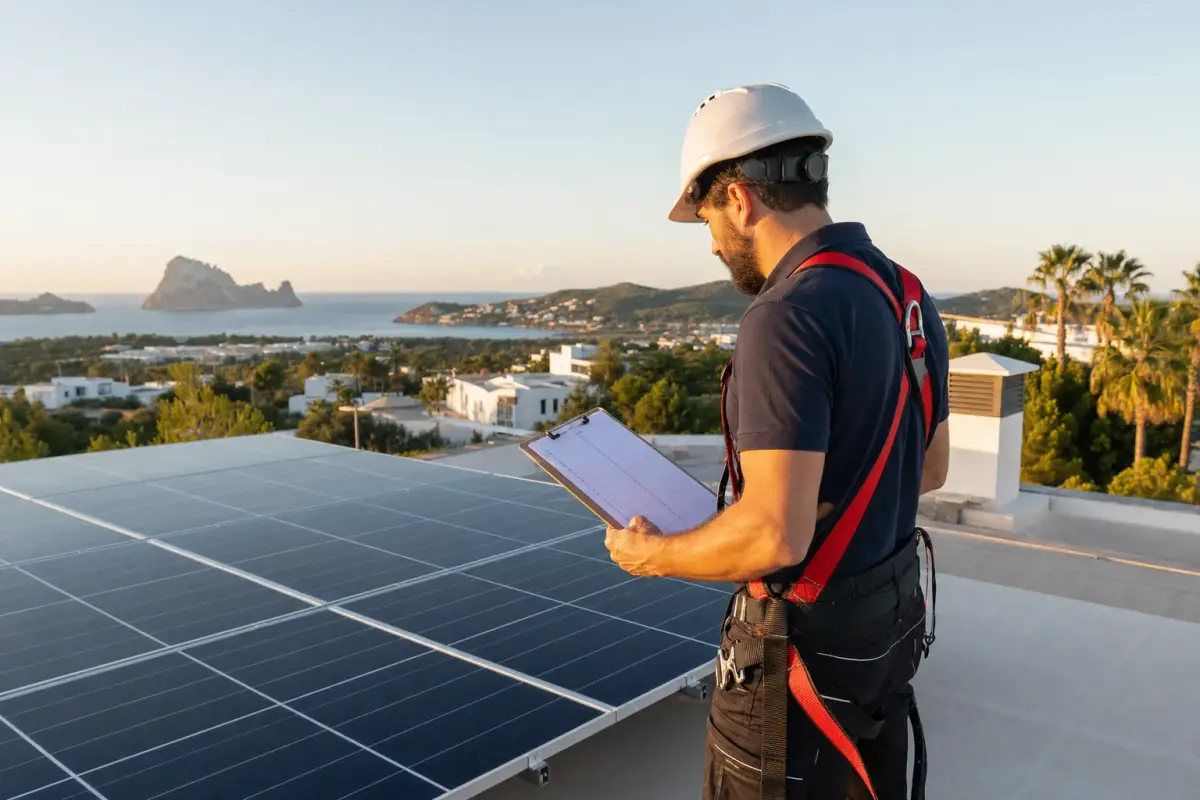
The solar boom in Ibiza has attracted both excellent specialists and operators who barely existed two years ago. Choosing the wrong installer can leak through silently for a decade: oversized inverter that fails at year eight, panels that lose 30 % output by year ten because they were never washed, warranties that legally do not apply because the installer is no longer registered. This guide gives you eight specific criteria — backed by documentation you can request before signing — to filter the seventy or so PV installers active on the island down to the three or four that can actually deliver a 25-year quality installation.
The eight filter criteria, in order of importance
Each criterion includes a specific document or evidence you should request. If the installer cannot produce it within 48 hours of asking, that is the answer.
| Criterion | What to ask for | Red flag | Key question |
|---|---|---|---|
| 1. RITE certification | Current valid REA-RITE certificate (number, expiry) | “It’s in process” / lapsed | ”Can I see the active REA registration?“ |
| 2. Civil liability insurance | Policy of at least €600.000 with valid year | No certificate or under €300.000 | ”Send me the current policy certificate.” |
| 3. Local recent portfolio | 3-5 references in Ibiza, last 24 months, with addresses | Only peninsula references | ”Can I visit two installations in Ibiza?“ |
| 4. Tier-1 equipment | Spec sheets for panel, inverter and battery | Generic brands, no datasheets | ”What’s the manufacturer 25-year guarantee?“ |
| 5. Detailed proposal | Itemised quote with kWp, components, labour, paperwork | Flat single-line price | ”Send me a Bill of Materials.” |
| 6. Written guarantee | Decennial structural + 10-year installation + manufacturer | Vague “satisfaction guarantee" | "What does the written warranty cover and exclude?“ |
| 7. Post-sale support | Documented maintenance contract option, response SLA | ”Call us if anything happens" | "Show me the annual service contract.” |
| 8. Bureaucracy management | Itemised list of permits managed in-house | ”You handle the paperwork" | "What paperwork is your fee for vs mine?” |
“Spanish residential PV warranties typically include a 25-year linear output guarantee on the panel itself, but only 10 years on the installation and the inverter. A real warranty is only as good as the entity standing behind it. Verify the installer’s tax registration, REA-RITE certificate and civil liability insurance at the moment of contract signature — not at the moment something fails.”
ASIT — Asociación Solar de la Industria Térmica, installer due-diligence guide 2026
The four red flags that should end the conversation
Door-to-door or telephone-cold sales. Premium villa installers do not cold-call. If you receive an unsolicited offer with same-day pressure to sign, walk away. Price 30 %+ below competing quotes. The materials cost is fixed at the wholesale level — radically lower prices come from cheap inverters, undersized DC cabling, no battery management, or no post-sale capacity. No physical office on the island. Companies that “fly in from the peninsula” have no incentive to honour a 10-year warranty. Refusal to put guarantees in writing. A verbal “yes, that’s covered” has zero legal weight if the company changes ownership or closes.
What to verify before signing — exactly
- Look up the installer’s CIF/NIF on the Spanish tax registry (gov.es Agencia Tributaria) — confirm it is active and not in bankruptcy proceedings.
- Request and verify the REA-RITE certificate on the Govern Balear database. The number should match the contracting entity, not a subcontractor.
- Verify the civil liability insurance certificate’s expiry date covers the entire installation period plus warranty.
- Cross-check at least two references in person — visit installations, talk to owners about year-2 and year-5 performance.
- Confirm in writing who manages the RAIPRE registry submission and the surplus compensation contract with the utility (covered in our PV regulation guide).
Why this matters more than the price
A solar PV system pays itself back over 7-10 years and operates for 25-30. The financial outcome is dominated by who can still service the system in year 12, not by who saved you €1.500 at year zero. The cheapest installer cost two clients of ours an additional €18.000 and €23.000 respectively over a decade in inverter replacements, premature panel failures and lost production — far more than the entire premium that would have purchased a tier-1 installation.
For most projects we coordinate the PV install with the broader villa systems — see solar PV pricing for Ibiza villas and our solar market analysis — so the installation choice is made in the context of the full property lifecycle, not as a standalone purchase.
Frequently asked questions
How many quotes should I request?
Three to four detailed quotes from installers that pass the eight criteria above. More than five becomes counterproductive — comparing five excellent installers wastes a month and the variation is usually within 8-12 %.
Should I prefer a local Ibiza installer or a larger peninsula brand?
Either works if all eight criteria are met. Local installers offer faster post-sale response (24-72h vs 1-2 weeks) and better knowledge of the Pitiusas regulatory environment. Larger national installers offer broader manufacturer relationships and more sophisticated financing. The best outcomes we have seen combine a local installer with a major-brand inverter and battery.
What is decennial liability and does it apply to solar?
Decennial liability (responsabilidad decenal, Article 17 LOE) covers structural failures linked to construction work for 10 years. For solar PV it applies if the installation modifies the roof structure or attachment. Confirm in writing that the installer accepts decennial liability for the mounting structure, not just the electrical components.
How long should the entire selection process take?
Three to four weeks from first contact to contract signature. Two weeks for initial filter, one week for site visits and detailed quotes, one week for negotiation and signature. Rushing below two weeks usually skips documentation verification; dragging beyond six weeks signals indecision or scope creep.
What if the installer recommends a smaller system than I expected?
Excellent sign. Quality installers size to real consumption, not to maximum roof capacity. An installer who proposes the biggest possible system is usually optimising their margin, not your return on investment. Insist on seeing the consumption analysis behind the sizing.