October 7, 2026
Solar PV Regulation and Permits for Residential Villas in Balearic Islands 2026
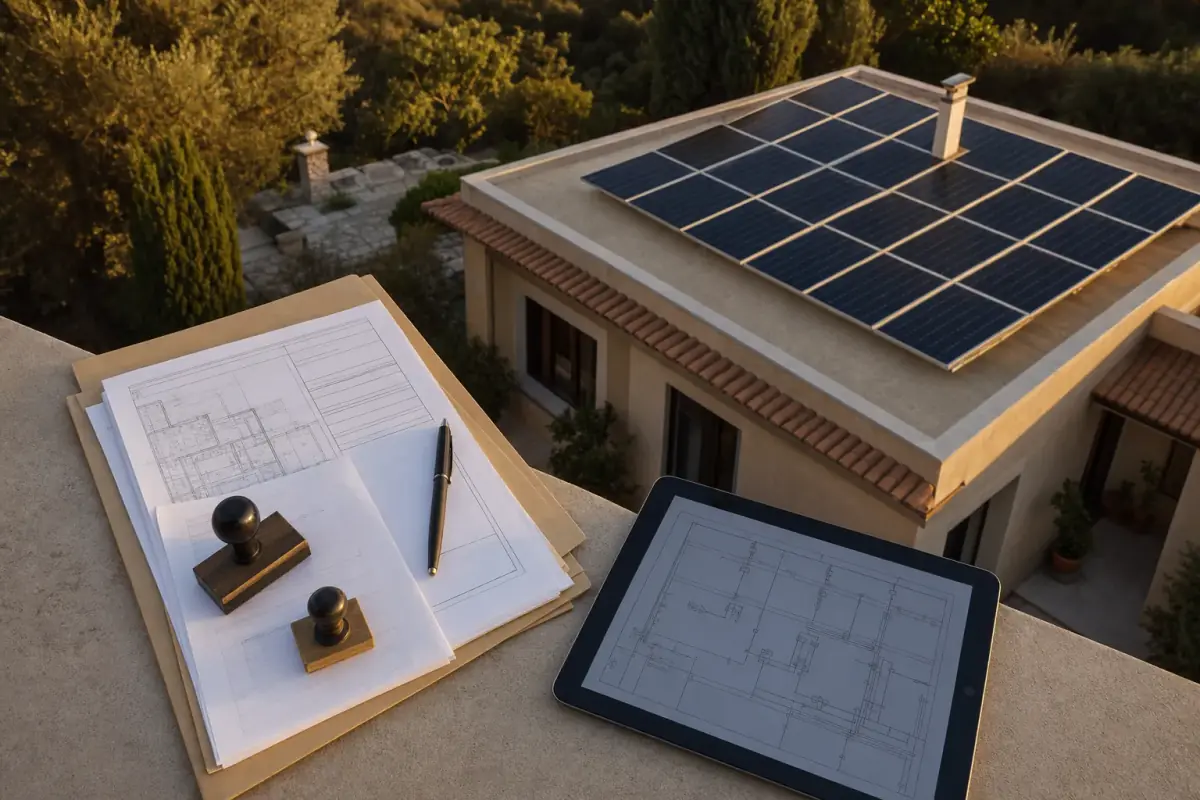
The technical work of installing solar panels on an Ibiza villa is fast — five days. The bureaucracy that surrounds it is not. A residential photovoltaic installation in the Balearic Islands triggers building permits at municipal level, electrical certifications at autonomic level, surplus compensation contracts at national level, and a registration in the RAIPRE database for everything to be legally operative. Getting one step wrong delays activation by months. This guide explains the full process in 2026, with the documents, the timeline and the typical fees.
Why Balearic Islands paperwork is heavier than peninsula
The Balearic Islands sit on top of the national framework (RD 244/2019 for self-consumption, Pliego de Condiciones técnicas of the IDAE) and add their own layer: autonomous environmental review for installations above 15 kW, mandatory community consultation in protected zones, additional fees for the Govern Balear registry. For a typical 5-15 kW residential villa installation, the autonomous overlay adds 3-5 weeks to the timeline a peninsula installation would face.
The full paperwork sequence, by installation size
| Step | Up to 10 kW | 10-100 kW | Timeline | Typical fee |
|---|---|---|---|---|
| 1. Technical project memo | Simple memo | Visado project (architect/engineer) | 1-2 weeks | €400-1.800 |
| 2. Municipal building permit | Declaración responsable | Licencia de obra | 2-6 weeks | €200-1.200 + ICIO 2-4% |
| 3. Environmental review | Not required | Govern Balear evaluation | 4-8 weeks (only >15 kW) | €0-650 |
| 4. Installation execution | 3-5 working days | 1-2 weeks | — | — |
| 5. Boletín eléctrico | RITE installer sign-off | Same | 1 day | Included in install |
| 6. RAIPRE registry | Govern Balear submission | Same | 2-4 weeks approval | €85 fee |
| 7. Compensation contract | With utility (Endesa, Iberdrola, etc.) | Same | 1-3 weeks | €0 |
| 8. IBI / tax bonifications | Apply to ayuntamiento | Same | 30-90 days approval | €0 |
“Residential photovoltaic self-consumption in the Balearic Islands is regulated by RD 244/2019 at national level and by Decret 33/2015 at autonomous level. Installations up to 10 kW benefit from the simplified procedure (declaración responsable). Above 10 kW the regime becomes a full licence with technical project and visado. Failing to complete the RAIPRE registration prevents the surplus compensation contract from taking effect, meaning excess production is lost rather than monetised.”
Direcció General d’Energia, Govern Balear, 2026 residential PV operational handbook
The four documents that decide whether you can install at all
Before the timeline starts, four documents determine whether the project is viable on a specific Ibiza villa:
- Cadastral certificate. Confirms the property exists with current measurements and ownership. A plot in “fuera de ordenación” (out of planning) regime may have additional restrictions for adding installations. See our note on the Balearic Rural Land Amnesty Law.
- Roof structural certificate. If the existing roof is older than 20 years, a structural engineer must certify it can bear the additional load (panels + mounting + wind suction).
- Electrical pre-existence certificate. Documents the current installation, neutral grounding scheme, breaker capacity. Often requires updates before PV can be connected.
- Heritage protection check. Properties in BIC-protected zones (Dalt Vila, certain rural areas) may need additional architectural compatibility approvals. Roof-integrated panels are often required instead of standard rack-mounted.
The tax bonifications that change the payback
Balearic Islands tax regime offers two specific benefits for residential PV: a Balearic income tax (IRPF autonómico) deduction of up to 50 % of investment capped at €3.000, and IBI (annual property tax) bonifications of 25-50 % for 3-5 years depending on municipality. Both must be requested in writing — they do not apply automatically.
For a typical 10 kWp installation costing €22.000, the combined tax effect reduces effective investment to €17.000-19.000, shortening payback by 1-2 years. This is documented in our detailed solar PV cost guide.
How IBOSSIM handles the paperwork
For our projects, we manage the full sequence in-house: technical project memo, municipal permit submission, structural certificate when required, RAIPRE registration with the Govern Balear, compensation contract with the utility, and the autonomous and municipal tax bonification applications. The client signs four documents during the project; everything else is handled by our technical office. Total timeline from contract signature to operational system: 8-12 weeks for installations up to 10 kW, 12-18 weeks above.
Coordination with the installer selection criteria and the broader building permit landscape in Ibiza 2026 is critical: an installer who does not manage the paperwork shifts that 60+ hours of administrative work onto the owner.
Frequently asked questions
Can I install solar on a property that is “fuera de ordenación”?
Generally yes, but with constraints. Out-of-planning properties cannot expand the built area, but they can typically host PV installations on existing roofs. Verify with the local ayuntamiento and confirm in writing before signing the installer contract. The Balearic Rural Land Amnesty Law may be a path to regularise the underlying property before installing.
What happens if I install without all the permits?
Three risks: (1) inability to register in RAIPRE means surplus production is lost rather than compensated, (2) inability to claim tax bonifications means the effective payback extends by 1-2 years, (3) in case of sale, the absence of legal documentation reduces resale value or blocks the transaction. Cost of regularising afterward is typically 3-5x the cost of doing it correctly upfront.
Do batteries require separate permits?
Batteries below 100 kWh and below 70 kW power output are included in the standard residential PV permit. Above either threshold (extremely rare for villas), additional fire safety and grounding certifications are required. For typical 5-15 kWh residential batteries, no additional permit beyond the main PV one is needed.
How long does the RAIPRE registration take?
Submission is online via Govern Balear telematic portal; approval typically takes 2-4 weeks if the documentation is complete. Common delays come from missing structural certificates, incomplete boletín eléctrico, or mismatched cadastral data. A well-prepared submission moves through in under three weeks.
What is the surplus compensation contract?
It is the contract with the electricity supplier (Endesa, Iberdrola, Naturgy, etc.) that monetises the electricity your panels produce in excess of your consumption. Compensation rate is typically 0.04-0.07 €/kWh in 2026, far below import tariffs (0.18-0.22 €/kWh), which is why correctly sized batteries and self-consumption are economically preferable to exporting surplus.