Bioclimatic Pergolas in Ibiza Villas: Orientation, Materials & Real Thermal Performance
A villa terrace in Ibiza that’s actually usable from June through September isn’t a matter of square meters or expensive furniture. It’s a matter of solar control. The difference between a terrace that bakes empty at 2 PM and one that hosts lunch every day in August usually comes down to a single decision: how the overhead shading is engineered. A well-designed bioclimatic pergola is the difference between a beautiful photo and a usable space.
This guide explains how a bioclimatic pergola works thermally, how it compares against alternatives like fixed porches or retractable awnings, which orientation choices matter on a Mediterranean coastal villa, and what materials hold up after fifteen years of sun and salt. It’s written for owners of luxury villas in Ibiza who are tired of paying for terraces nobody uses past 11 AM.
Why a bioclimatic pergola matters on a luxury Ibiza terrace
The Pitiusas receive between 2,800 and 3,000 hours of sun per year. South-facing terraces in coastal villas regularly hit surface temperatures above 50 °C in July and August. Standard fixed shading — wood pergolas, fabric canopies, even pergolas with permanent slats — manages this load with a single static solution that’s wrong most of the time: too closed in May and October when you want sun, too open at noon in August when you don’t.
A bioclimatic pergola changes that by giving you active solar control. The aluminum louvers rotate on their axis from 0° (fully open, no shade) to 135° (overlapping, fully closed and watertight) and every angle in between. You can adjust them by remote, by app, or hand them over to sensors that read sun position, rain and wind in real time. The result, on a south-facing terrace in Ibiza, typically translates to 5–8 °C lower ambient temperature beneath the structure at peak midday compared to an open terrace.
The thermal mechanism, in one paragraph
Closed louvers reflect 70–85% of direct solar radiation back to the sky depending on color and finish. At the same time, with louvers angled (rather than horizontal), the air below the pergola circulates by chimney effect: hot air escapes upward through the slats while cooler air enters from the sides. That convective movement is what brings the perceived temperature down. A static porch traps that hot air; a bioclimatic pergola releases it.
Bioclimatic pergola vs retractable awning vs fixed porch
Before specifying a pergola, it’s worth understanding what you’re not buying. Each of the three common solutions has its place — the question is which one fits the way you actually use the villa.
| Criterion | Bioclimatic pergola | Retractable awning | Fixed porch (wood/concrete) |
|---|---|---|---|
| Cost installed (€/m²) | 650–1,100 | 180–400 | 900–1,800 (depending on finish) |
| Real lifespan in coastal Ibiza | 15–20 years | 5–8 years (fabric replacement) | 30–40 years (structure) |
| Estimated thermal saving vs open terrace | 5–8 °C beneath structure | 2–4 °C | 3–5 °C (static) |
| Solar control | Active (0–135° + automation) | Binary (open / retracted) | Static (no adjustment) |
| Watertight closed | Yes (with drainage channels) | Partial (fabric) | Depends on construction |
| Resistance to Tramuntana wind | Up to 100–130 km/h (sensor auto-closes) | 40–60 km/h before retract | Excellent (fixed) |
| Building permit required | Minor works permit (most cases) | Usually exempt | Major works permit |
| Property value uplift (estimated) | +1.5–3% on appraisal | +0.3–0.7% | +1–2% |
“Bioclimatic architecture isn’t a style. It’s a discipline of designing buildings — and their extensions — that use orientation, materials and operable elements to control the indoor climate passively, reducing energy demand for heating and cooling by 20–40% compared to conventional construction.”
IDAE — Instituto para la Diversificación y Ahorro de la Energía, Guía técnica de arquitectura bioclimática
Orientation: the one decision that determines everything
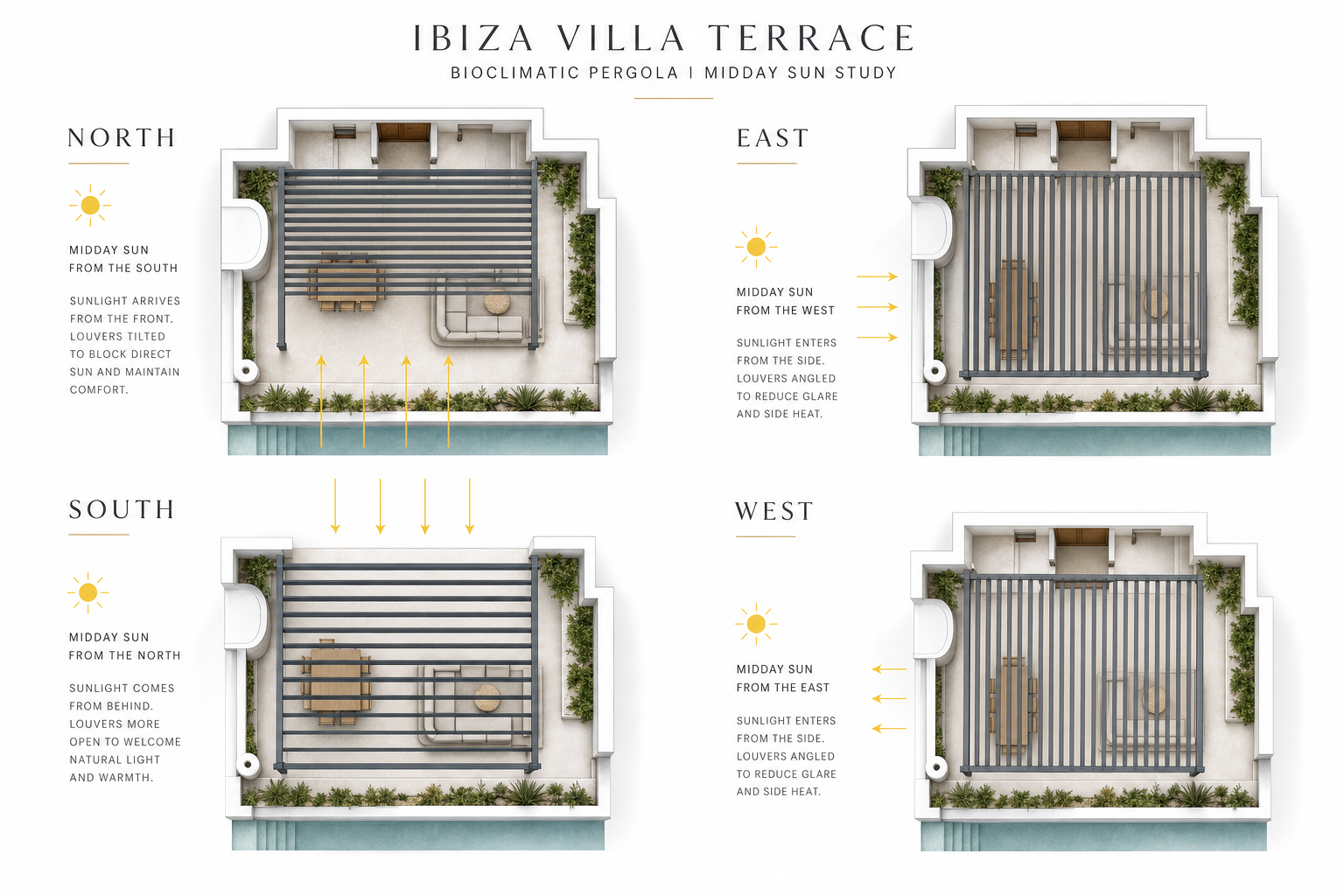
If you only get one variable right, get this one. The orientation of the louvers (and the pergola as a whole) decides how much sun the terrace receives at which time of day. Across the four cardinal orientations of an Ibiza villa, the optimal louver configuration changes drastically.
- South-facing terraces: louvers oriented east–west. In summer, closed at midday to block high sun; reopened at 4–5 PM when the angle drops. Sensors automate this perfectly.
- West-facing terraces: louvers oriented north–south. The challenge is the low, intense afternoon sun (4–8 PM in summer). Closed louvers in late afternoon become essential for terrace use.
- East-facing terraces: louvers oriented north–south. Critical for morning sun (7–11 AM); often the easiest orientation to manage because afternoon sun is gentler.
- North-facing terraces: rarely receive direct sun on Ibiza’s latitude. The pergola’s job here is mostly rain protection and visual structure, not thermal control. Often a lighter version (or a fixed pergola) is enough.
One detail that’s often overlooked: the height of the pergola affects the angle of solar incidence at the edges. A 3 m clearance is the minimum we specify on a luxury terrace. Below that, the structure feels low and the louvers don’t have room to manage low afternoon sun on west-facing terraces without closing entirely.
Materials that survive 15 years of Ibiza sun and salt
The structural and louver materials decide how long the pergola lasts and how much maintenance it asks of you. In a coastal Mediterranean environment with daily salt aerosol and intense UV, the wrong choice fails within 5–7 years.
- Structural frame: 6063-T5 or 6082 aluminum with marine-grade powder coating (60–80 microns). Avoid steel even when galvanized — the salt aerosol penetrates the galvanization layer within a decade and rust spots appear at welds.
- Louvers: double-skin extruded aluminum (not single-skin) with rotation motors rated IP66. Single-skin louvers warp under direct sun and lose alignment.
- Finish color: light tones (white, sand, light grey) reflect more radiation and stay cooler to the touch. Anthracite and black look striking in photos but reach 75–85 °C surface temperature in August — they radiate heat downward to occupants.
- Fasteners: all bolts, brackets and hinges in AISI 316 stainless steel (marine grade), not 304. The cost difference is small; the rust difference is enormous.
- Gaskets and seals: EPDM or silicone rated for 25-year UV exposure. Cheaper rubber gaskets crack within 3 summers.
Smart automation: sun, rain and wind sensors
A bioclimatic pergola without sensors is a manual umbrella. The value of the product appears when the louvers respond to ambient conditions on their own. Three sensors are non-negotiable on a luxury installation:
- Solar sensor: closes louvers when radiation exceeds a programmable threshold (typically 600 W/m²), reopens when shading is no longer needed.
- Rain sensor: closes louvers to a watertight position the second precipitation starts. Crucial in Ibiza autumn storms — protects the terrace furniture you spent five figures on.
- Anemometer (wind sensor): opens louvers when wind exceeds ~80 km/h. This protects the structure itself — closed louvers in heavy wind act like a sail and can damage motors and hinges.
On top of that, integration with the villa’s home automation (KNX, Loxone, Control4) lets you script behaviors — for instance, opening the louvers automatically 30 minutes before sunrise on the east-facing terrace so the breakfast table catches the morning light without you touching anything. This sort of integration is what we mean when we talk about energy efficiency in a luxury villa: not just installing equipment, but having the equipment talk to itself.
Permits, costs and what owners actually pay for
In Ibiza, a bioclimatic pergola requires a licencia de obra menor (minor works permit) in almost every municipality. The exception is on listed properties or in protected rural zones, where the requirements escalate quickly. The permit fee itself is modest (typically 0.3–0.8% of project value), but the technical project required to apply costs €700–1,500 depending on size.
Total turnkey cost for a quality bioclimatic pergola on an Ibiza villa lands between €650 and €1,100 per square meter depending on:
- Brand and louver technology (Renson, Biossun, Saxun and Gibus dominate the premium segment).
- Span (anything above 6×4 m requires intermediate posts or upgraded structure).
- Automation level (basic motor vs full sensor suite vs home automation integration).
- Lateral closures (glass walls, fabric blinds, integrated lighting).
- Foundation work (slab in good condition vs new footing required).
The price gap between a “pergola brand new” at €450/m² and a properly engineered premium installation at €1,000/m² is real and visible. The cheap ones fail in 5 years; the good ones still work after 15. For a luxury villa, the math nearly always favors the premium tier.
How IBOSSIM approaches a pergola project
Three things shape every pergola we install. First, a site visit at two different times of day — usually 11 AM and 5 PM — to read how the sun actually hits the terrace, including reflections from pool, white walls and neighboring buildings. The site visit changes recommended louver orientation about a third of the time compared to what the original blueprint suggested.
Second, structural verification of the existing slab or roof if the pergola attaches to the building. A 6×4 m pergola weighs 350–500 kg before snow or wind loads; if the slab below isn’t engineered for that, we redesign the anchoring before quoting. We’ve walked away from projects where the existing structure couldn’t take the load and the client wasn’t willing to reinforce — better than installing something destined to fail.
Third, we coordinate with whoever’s handling the villa’s automation. Pergolas that aren’t on the same network as the lights, audio and HVAC end up being remote-control-only, which means nobody uses the automation features after month two. The cost of integration during installation is small; retrofitting it later costs more than the original installation.
FAQ
How long does it take to install a bioclimatic pergola in Ibiza?
From signed contract to commissioned installation, expect 8–12 weeks. About 4–6 weeks of that is manufacturing lead time (most premium brands manufacture on order in continental Europe), 2–3 weeks for the municipal permit, and 5–8 working days on site for the installation itself.
Can a bioclimatic pergola be installed on a flat roof / terrace upstairs?
Yes, provided the structural slab can carry the load (typically 100–150 kg/m² including loads) and the waterproofing membrane is preserved. We use chemical anchors with sleeve protection over the membrane and isolate the foot of the post with a vulcanized EPDM seal. This is one of the most common installations on Ibiza luxury villas.
Does the louver finish color really matter?
Yes, both aesthetically and thermally. Light colors (white, sand, light grey) reflect 60–75% of solar radiation, stay cool to the touch and prolong gasket life. Anthracite or black absorb most of the radiation, can reach 80 °C surface in August, and visibly age gaskets and seals faster. If the brief says “anthracite” for aesthetic reasons, we recommend a thermally optimized version with double-skin and ventilated profile.
What’s the warranty I should expect?
Premium European manufacturers offer 10 years on structure, 5 years on motors and 2 years on electronics. Installation warranty from a serious local installer adds 2 years on the installation itself. Avoid pergolas with 2-year structural warranty — that’s a tell that the manufacturer doesn’t trust their own product in marine environments.
Is it worth retrofitting sensors to an existing pergola?
If the existing pergola is from a major brand and less than 8 years old, yes — manufacturers usually offer retrofit sensor kits compatible with their motors. If the pergola is older or from an unknown brand, the wiring and motor protocol may not support retrofit and the cost approaches a new installation.
A terrace works for 11 months of the year — not 4 — when the shading is engineered correctly. If you’re thinking about turning a south- or west-facing terrace into the most-used room of the villa, talk to us before specifying anything. The site visit takes an hour and changes the project on a third of the cases.
Related reading: How to Optimize Energy Efficiency in Luxury Villas in Ibiza · Outdoor Kitchens and BBQ: Fire Prevention Regulations in Ibiza.