
Rainwater Storage Systems for a Self-Sufficient Villa in Ibiza
The numbers behind a self-sufficient villa in Ibiza start with the cistern. A 250 m² roof in a year with 450 mm of rainfall collects around 100,000 litres of usable water — enough to supply the entire garden irrigation of a luxury villa for the whole dry summer, plus toilet flushing for a family of six. The catch is that none of it is useful if the storage system underneath isn’t properly engineered. Volume, materials, normativa and integration with the rest of the plumbing decide whether your rainwater becomes a real resource or a quarterly cleaning bill.
This guide is the technical companion to the broader topic of rainwater harvesting. If you want the panoramic view of why rainwater reuse matters on the island, our existing article on rainwater harvesting and reuse in Ibiza villas covers that. Here we go deep into the storage layer: cistern types, sizing math, what’s allowed under Baleares water regulations, and the integration details that decide whether the system performs at year 1 and at year 15.
Why storage volume is the single most important spec
Two villas with identical roofs and identical collectors can have radically different water autonomy depending on cistern volume. Ibiza’s rainfall is concentrated in 4 months (October–February) but the demand is concentrated in the 4 driest months (June–September). The cistern has to bridge those two timing curves; if it’s too small, you fill it twice in November and dump excess into the storm drain instead of saving it for August.
A rough sizing rule we apply to luxury villas in Ibiza: target a cistern capacity equal to at least 30% of the catchment yield in an average rainfall year. For a 250 m² roof with 450 mm/year, that’s around 30 m³ minimum, with 50 m³ being the sweet spot for villas that want serious irrigation autonomy. Going above 75 m³ on a typical villa usually doesn’t pay back — by then you’re sizing for catastrophic dry years which, statistically, you’ll see one every 8–10 years.
The three cistern types: cast concrete, polyethylene tank, traditional aljibe
Each system has a clear context where it makes sense. The differences are real (cost, lifespan, maintenance, aesthetics, structural integration), and choosing right depends on whether you’re retrofitting an existing villa, building new, or restoring a traditional finca.
| Cistern type | Typical capacity | Real lifespan | Cost per m³ installed | Annual maintenance | Aesthetic integration | Applicable regulation |
|---|---|---|---|---|---|---|
| Cast-in-place reinforced concrete | 20–100+ m³ (custom) | 50+ years | €350–600 | Visual inspection annually, full clean every 5 years | Buried, invisible above ground | CTE-DB-HS-4, ABAQUA Baleares |
| Modular polyethylene tank | 3–25 m³ (modules combinable) | 20–30 years | €220–380 | Internal clean every 3 years | Buried; access hatch at ground level | UNE-EN 13280, certified potable |
| Restored traditional aljibe | 10–50 m³ (existing geometry) | 100+ years (already proven) | €450–700 (restoration cost) | Inspection every 2 years, lime render maintenance every 10 | Patrimonial value, often visible architectural feature | Heritage protection if listed |
For a luxury new build, we typically specify cast-in-place reinforced concrete with three reasons: lifespan (50+ years on a project where the rest of the construction is also designed for 50+), customizable geometry that uses the available basement footprint efficiently, and the ability to integrate it with a structural slab so the cistern adds to the building’s stability instead of being a satellite element.
For retrofits, polyethylene modular tanks win on excavation cost and installation speed: modules go through standard doorways, assembly is days not weeks. The trade-off is the 20-30 year lifespan ceiling, which we now mention to clients explicitly so they’re not surprised in 2050.
Restored traditional aljibes — the buried stone-and-lime cisterns common in old payés constructions — are an underrated option when restoring a finca. They’re already structurally proven, often hold 20–40 m³ of capacity that you’d otherwise have to excavate, and they have heritage value that can satisfy patrimonial requirements in protected zones. The restoration replaces the interior lime render and any cracked stones; the original geometry stays.
“Las Illes Balears tienen una capacidad de almacenamiento de agua naturalmente limitada y una demanda creciente. La gestión privada del agua de lluvia en viviendas particulares — captación, almacenamiento, reutilización — es una palanca real de sostenibilidad hídrica en la isla, y la normativa autonómica facilita progresivamente estos sistemas en suelo rústico y urbano.”
ABAQUA — Agencia Balear del Agua y de la Calidad Ambiental
What the regulation actually says (Baleares, 2026)
Rainwater storage on residential properties in Ibiza falls under three regulatory frameworks: the national Building Technical Code (CTE-DB-HS-4 for water supply), the Balearic water plan (Plan Hidrológico de las Illes Balears), and the municipal urban planning ordinance for each specific zone. For a luxury villa, the practical implications are:
- Cisterns up to 20 m³: typically integrated into the building permit (licencia de obra) without separate processing. New construction in rustic land in many municipalities requires a minimum cistern volume tied to roof area.
- Cisterns 20–100 m³: may require additional environmental report for protected zones, and Consell Insular d’Eivissa intervention if the property is in protected rural soil.
- Use restrictions: rainwater stored for non-potable uses (irrigation, toilet flushing, washing) is unrestricted. For potable use (drinking, cooking, showering), you need filtration certified for human consumption and the cistern must meet UNE-EN 13280 or equivalent.
- Connection to mains: cross-contamination between rainwater and mains supply is forbidden and inspected. A physical air gap is mandatory at any joining point.
- Overflow management: cistern overflow must go to a registered drainage point (storm drain, infiltration well, or back to garden). Cannot discharge directly to a neighbor’s property.
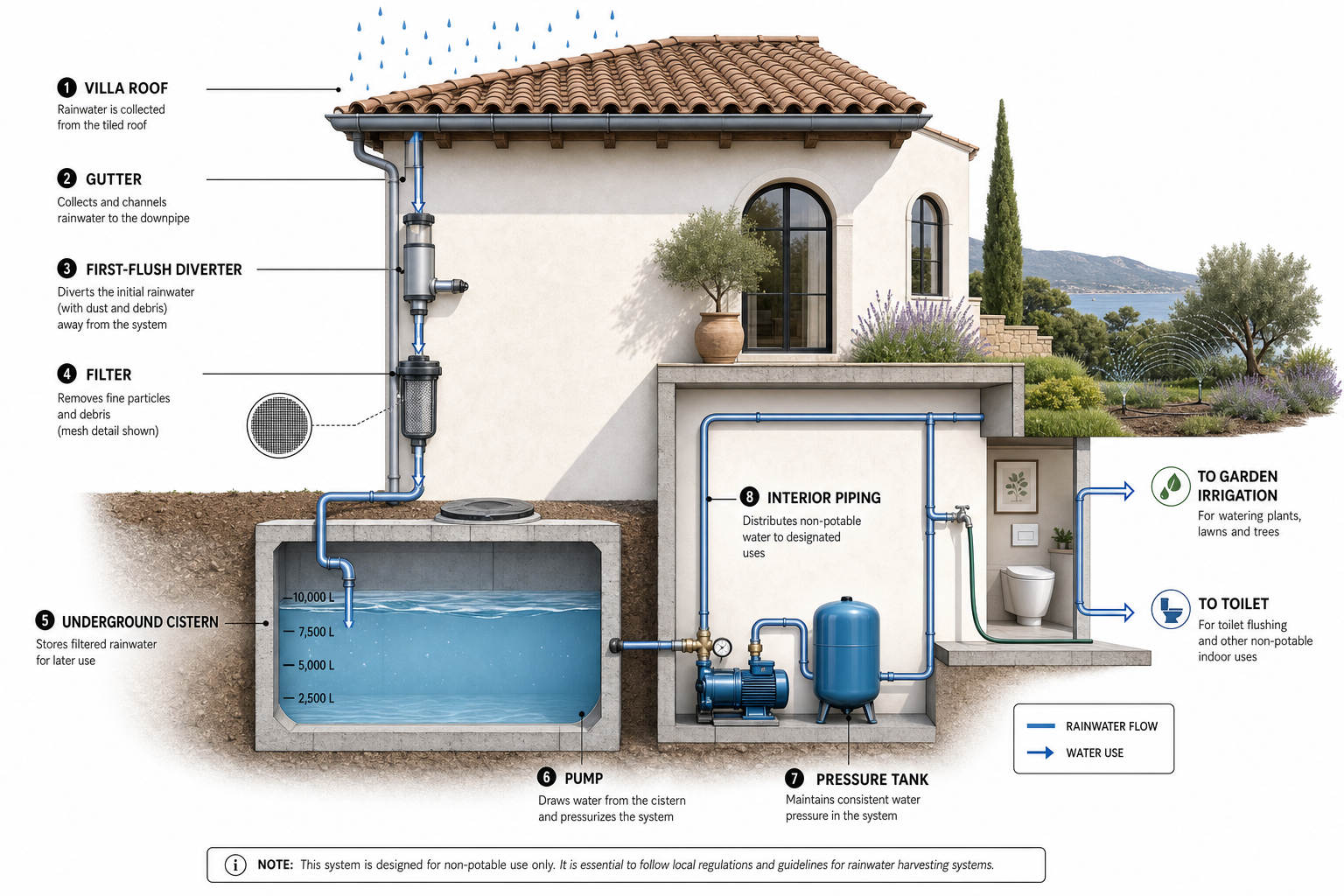
The complete system: from roof to use point
A working rainwater storage system on an Ibiza villa is a series of layers, each with its own technical purpose. Skip any and the system underperforms or contaminates.
- Catchment surface (the roof): tile is the most common; metal roofs collect 5-10% more (less absorption). Avoid copper or zinc roofs if rainwater will be used for irrigation of edible plants — heavy metal trace contamination.
- Gutters and downpipes: properly sized for peak rainfall intensity (Ibiza can deliver 30 mm/hour in a Mediterranean storm). Undersized gutters overflow and waste the resource.
- First-flush diverter: the first 1–2 mm of rainfall washes dust, bird droppings and roof debris off the surface. This dirty initial volume diverts away from the cistern. Critical for water quality.
- Pre-tank filter: 200-300 micron mesh to stop leaves, larger debris and insects before water enters the cistern. Cleanable.
- Cistern with calm-water inlet: water enters at the bottom of the cistern via a curved deflector so sediment isn’t stirred up. Sediment compacts on the floor over years; if water is dumped from height, it mixes back in.
- Floating intake / extraction: the pump draws water from 15–30 cm below the water surface, where the cleanest water is. Not from the bottom (sediment) and not from the very surface (debris). A floating intake with a screened end achieves this.
- Pump and pressure tank: sized for the peak demand. For a villa with toilet flushing + 200 m² of irrigated garden, typically 1.0–1.5 HP pump with a 60-80 L pressure tank.
- UV sterilization (for non-potable but hygienic uses): kills bacteria without chemicals. Standard on premium installations even for non-potable uses to prevent biofilm in piping.
- Distribution piping: in PE or PP-R, physically separate from mains supply piping. Different color labels to prevent cross-connection during maintenance.
Integration with the rest of the villa’s water strategy
A rainwater cistern that operates in isolation captures rainwater. A cistern that’s integrated into the villa’s overall water strategy operates as part of a system that includes the pool backwash recovery, gray water reuse, smart irrigation controller, and the mains supply itself. Integration is where the real efficiency happens.
Three integrations are worth specifying from day one. First, automatic switching between rainwater and mains: when the cistern level drops below a setpoint, a smart valve cuts in the mains supply for the relevant circuits. The owner never has to think about it; the system reports usage by month. Second, integration with the irrigation controller so smart irrigation knows how much water is in the cistern and adapts the schedule. Third, integration with the property’s building permits documentation — a documented rainwater storage system can support arguments for sustainability scoring in future regulation.
How IBOSSIM approaches a cistern project
Three protocols on every cistern project. First, a precipitation analysis specific to the property using the closest AEMET weather station (typically 5–8 km from the villa). Average annual rainfall, dry-year worst case, peak intensity. From those numbers we size the cistern, gutter dimensions and overflow path — never from generic island averages, because microclimate variation across Ibiza is significant.
Second, structural integration. If the cistern is new and the villa is in renovation, we integrate it into the foundations design. A 30 m³ cistern adds 30 tons of dead load when full; in the wrong place, that’s a structural problem. In the right place, it’s a structural asset (stabilizing weight, lower center of gravity).
Third, a 25-year service plan handed over with the installation. Not a glossy brochure: a real calendar marking when the first-flush diverter needs cleaning, when the cistern needs draining and inspecting, when the UV lamp needs replacing. Without that, owners forget. With it, the system performs as designed at year 15.
FAQ
How long does it take to install a new cistern?
For a cast-in-place concrete cistern of 30–50 m³: 5–7 weeks from excavation to commissioning. Polyethylene modular: 2–3 weeks. Restoration of an existing traditional aljibe: 3–4 weeks depending on initial condition.
Can the cistern be installed under the pool deck?
Yes, and it’s often the most space-efficient location. Requires a properly designed bearing structure between cistern and pool deck. Inspection access (450×600 mm minimum) must remain accessible from a discreet location on the deck.
Is rainwater stored in a cistern safe for the pool?
For top-up only, yes, after appropriate chlorination. Not as primary fill (the chemical adjustments would be heavy). For irrigation, completely safe with the filtration described above.
Does a rainwater system need building permits?
For new construction or major renovation, yes (it’s part of the licencia de obra). For retrofit installation alone, depends on volume: small modular tanks may qualify as minor works; large concrete cisterns require permits.
Is the payback worth it on a luxury villa?
For a 50 m³ system saving 80–120 m³ per year at €4–7/m³ (Ibiza restricted-period mains pricing), the direct payback is 12–18 years on the cost of the storage subsystem. On a luxury villa, the case is rarely about that direct payback — it’s about water autonomy in restricted periods (when mains is rationed) and the documented sustainability that supports property value.
A properly engineered rainwater storage system on an Ibiza villa is one of the few infrastructure investments that gets more valuable as water becomes more restricted on the island. Sized correctly, integrated with the rest of the water strategy and maintained on schedule, it works for 50+ years. The first step is a precipitation and roof analysis specific to your property.
Related reading: Rainwater Harvesting and Reuse in Ibiza Villas (panoramic guide) · Building Permits in Ibiza 2026.